Why we live Jaipur before nine
The light: the walled city faces the morning sun along its main bazaars, and the pink walls glow coral for the first hour, then flatten as the sun climbs.
The quiet: the arcades are still shuttered, so you can actually see the architecture, the carved brackets, the painted arches and the long run of identical shopfronts.
- Founded
- 1727, by Sawai Jai Singh II
- The grid
- Nine blocks, bazaars meeting at great squares
- Old-city UNESCO listing
- 2019
- Traffic builds
- From about nine
- Light
- Warmest in the first hour after sunrise
- The people: this is the hour of milkmen, priests, sweepers and schoolchildren. Nobody is selling you anything yet.
- The temperature: even in April, the first two hours of the day are pleasant. By noon from April to June, you will want to be beside a pool.
- The trade-off: an early alarm. We make it gentle, with tea at the door and a car waiting, and the rest of the day is yours to rest.
Before dawn: bells, milk and pigeons
The pigeons: at the great squares, men scatter grain from sacks each morning. Feeding the birds is a daily act of merit that some families have paid for over generations.
The milk: dairymen ride in from the villages with steel cans and stop at the sweet shops. By noon that milk has become rabri and kalakand.
- The cows: many households keep the first roti of the day for the cow that waits at their door. Every lane has its regulars.
- The shopkeepers: they wash their steps, light incense at the little shrine above the counter, and hang lemon and green chillies over the door against the evil eye.
- The sweepers: long brooms along the arcades, working from one end of the bazaar to the other before the crowds arrive.
- The chai stalls: the first stoves are lit while the street lights are still on. Cutting chai, half a glass, strong and sweet, is how the city wakes up.
Sunrise on Hawa Mahal

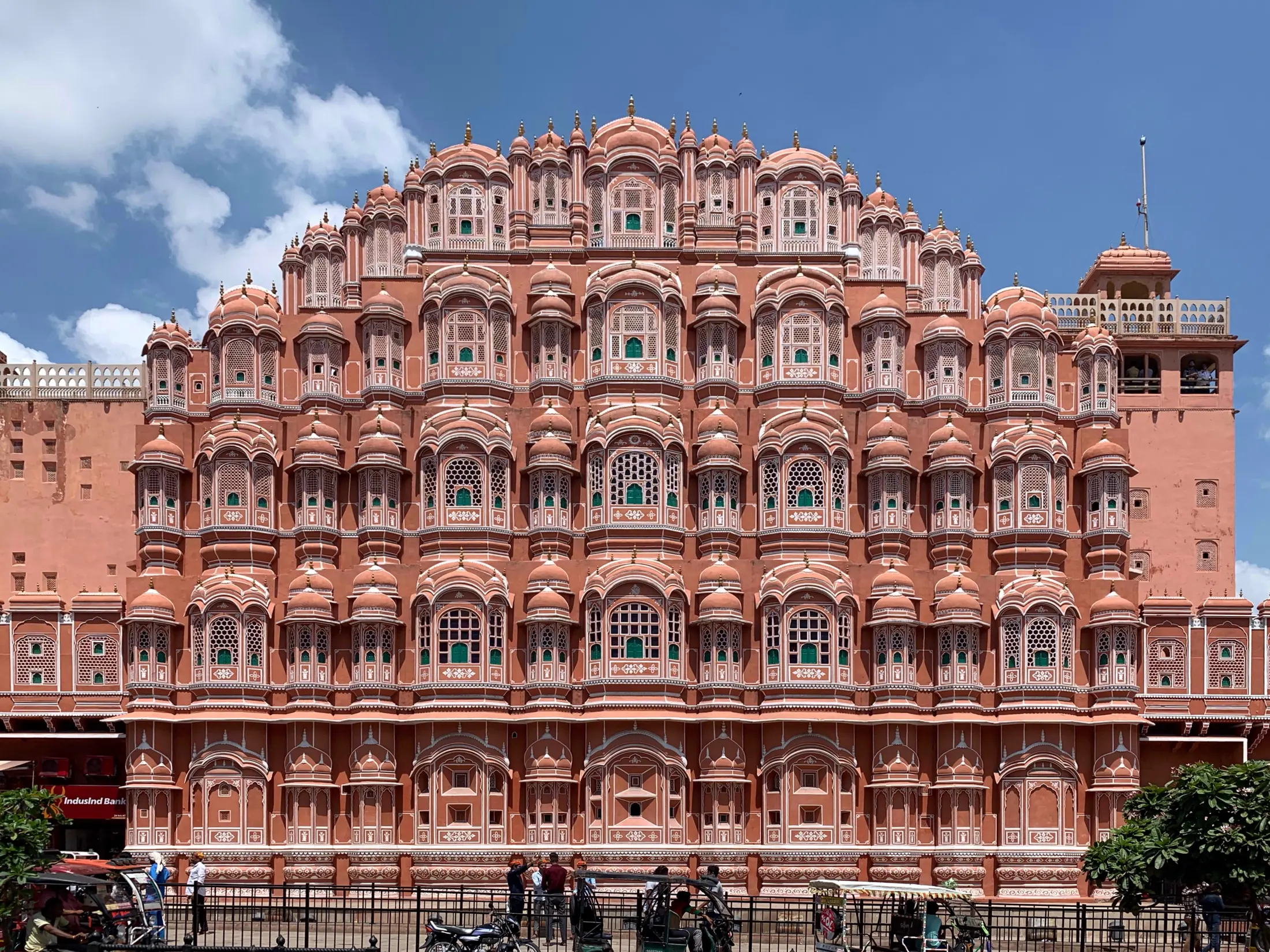
Why sunrise: in the first hour the facade catches the light full on and the pink turns warm coral. By mid-morning the sun is overhead and the building goes flat.
Where to stand: across Siredeori Bazaar, or better, on a rooftop opposite with masala chai. The height lets you see the whole honeycomb of windows.
- Built
- 1799, by Maharaja Sawai Pratap Singh
- Architect
- Lal Chand Ustad
- Windows
- 953 jharokhas and latticed openings
- Height
- Five storeys, about 15 metres
- Best hour
- Just after sunrise, for the facade
- What it was for: the screen let the royal women watch processions in the street without being seen, and the windows funnel breezes through the building.
- Go inside as the gates open: most people only photograph the front. The rooms behind are cool, quiet and full of coloured light from the glass.
- What to look for from the top: the instruments of the Jantar Mantar below, and the long straight lines of Jai Singh's grid.
Our full guide
- Read more: the story of the poet-king, the rooms floor by floor and what most visitors miss are in our Hawa Mahal guide.
Morning darshan at Govind Dev Ji
Where: in the palace garden north of the Chandra Mahal, inside the City Palace complex, with its own entrance open to all.
Who he is: Govind Dev Ji, Krishna as the cowherd god. The image was brought to Jaipur from Vrindavan, and the Kachwaha kings regarded themselves as his first servants.
- The line of the city: the royal residence faces the temple through the gardens. Stand at the right spot in the palace and you are looking along the spine Jai Singh planned.
- What darshan means: a sight of the deity. Several times a day the curtain is drawn back for a jhanki, and the crowd breathes in together.
- The early one: crowded, joyful and full of singing. Elderly neighbours, young couples, office workers on their way in, all shoulder to shoulder.
- How to join: shoes off, shoulders covered, phone away. Stand towards the back and let the crowd move you. Nobody minds a respectful visitor watching.
The bazaars as the shutters lift

Choti Chaupar, the vegetable square
When: as the carts set up, soon after first light.
- What you see: mountains of seasonal vegetables, coriander by the armful, green chillies and, in winter, carrots so red they look painted.
- Why we go: this is where Jaipur households still shop. It is the least touristy hour in the most famous part of the city.
Tripolia Bazaar and Maniharon ka Rasta
- On the main street: brass, steel utensils and household goods, the shutters going up one by one past the triple-arched Tripolia Gate.
- In the lane: families shape lac bangles over small charcoal fires and press glass and stones into the lac while it is warm. Mornings are when the fires are lit.
Johari Bazaar, the jewellers' street
- Before the shops open: you can see the facades properly, the long run of arcades and the upper storeys that are hidden by crowds after ten.
- The trade: Jaipur is one of the world's great centres for cutting coloured gemstones. Our gems and jewellery page explains how we buy safely.
The flower sellers
- Where: outside the temples and along the bazaars, threading marigolds and roses into garlands for the day's worship.
- Why it matters: every shop, shrine and household buys flowers in the morning. By nine, the strings are gone.
Breakfast the way Jaipur eats it
Pyaaz kachori: a flaky fried pastry filled with spiced onion. The famous counter is Rawat Mishthan Bhandar near Sindhi Camp, and it is busy from early morning.
Lassi: a clay cup of thick sweet yoghurt from Lassiwala on MI Road, thick enough to stand a spoon in. It sells out by lunchtime, so go early.
- Cutting chai: half a glass, strong, milky and sweet, at the stall on the square. Order two. The first is gone before you notice.
- Jalebi: spirals of fried batter, crisp and hot from the syrup, from any busy halwai's pan. Look for the shop with the queue.
- Sweets for later: LMB, the old Laxmi Mishthan Bhandar in Johari Bazaar, for a box of sweets, and ghevar if you come in the Teej season.
- How to stay well: eat where the food is fried in front of you and the turnover is high. Hot and fresh is safe. Our food of Jaipur guide has the full list.
Other mornings worth an early alarm

Amber Fort, as the gates open
- Why early: arrive at opening time and you have the Sheesh Mahal, the hall of mirrors, almost to yourself.
- Where: 11 kilometres north of the city, above Maota Lake. We walk or drive guests up, and we don't book elephant rides.
Jal Mahal at first light
- Why early: the lake is still, the Aravalli hills behind are blue and the palace seems to float.
- In winter: migrant ducks fill Man Sagar, and birders come before the traffic does. It sits on the road to Amer, so it pairs well with the fort.
Galtaji in the valley
- Why early: pilgrims bathe in the spring-fed tanks, and the macaques are calm before the day's visitors arrive.
- How: carry nothing that looks like food, and climb to the Surya Mandir on the ridge for a view back over the city.
A hot-air balloon over the hills
- What it is: a sunrise flight of about an hour over the countryside near Amer and Samode, with a pick-up in the dark.
- When: the cool months, roughly October to March. Keep a second morning free in case the wind cancels the flight.
The old city by bicycle
- What it is: a gentle ride from Chandpole Gate along the spine of the grid to Badi Chaupar, finishing beneath Hawa Mahal as the sun reaches it.
- Who it suits: the curious and the restless, and families with children of about ten and over. A car follows if anyone tires.
Festival mornings

Makar Sankranti, 14 January
- At dawn: families climb onto their rooftops with spools of thread, and the first kites go up before breakfast.
- By midday: the sky over Hawa Mahal is full of paper, and every roof is shouting woh kata, the cry when you cut someone's kite loose. Read about Makar Sankranti.
Holi
- The night before: bonfires for Holika Dahan in the squares and lanes.
- The morning: coloured powder, music and water from about breakfast until lunch. We plan a private celebration in a haveli courtyard for guests who want it gentler. See Holi in Rajasthan.
Gangaur and Teej
Diwali
- The morning after: the bazaars are still strung with lights, families visit relatives with boxes of sweets, and the old city smells of marigolds and smoke. See Diwali in Rajasthan.
A Jaipur morning through the year
Winter: the light is golden and the air sharp. Bring a shawl, gloves for a balloon flight and a warm hat for the rooftop.
Spring: February and March are our favourite mornings, with mild air, mustard fields around Amer and the run-up to Holi and Gangaur.
- October to March
- Comfortable mornings, the main season
- December and January
- Crisp dawns, sometimes close to freezing
- April to June
- Out at first light, back by about eleven
- July to September
- Rain-washed skies, short showers, few crowds
- Summer: start in the dark and finish early. The old city at six in May is lively, because everyone else is avoiding the heat too.
- Monsoon: the sky after rain is washed clean and the sandstone darkens to a deep rose. Some of our best photographs of Hawa Mahal were taken in August.
- Month by month: our best time to visit Jaipur guide covers every month in detail.
How we plan a morning for you
Tea at the door: a knock, a flask of tea and something small to eat. Nobody should walk the bazaar on an empty stomach.
A car at the gate: your chauffeur drops you at Badi Chaupar or Chandpole while the street lights are still on, and waits where we finish.
- A guide who grew up here: private, local and commission-free. They point out the date carved over a haveli door and the shop that has sold brass lamps for generations.
- No shopping detours: our guides are paid never to steer you to a showroom. If you want to buy, we take you to families we have known for decades.
- Back by nine: in time for a proper breakfast at your hotel, a shower and a slow start to the rest of the day.
- The afternoon off: a long lunch and a rest, then the City Palace in the late afternoon or Nahargarh for sunset.
Small courtesies of the morning
Greet first: khamma ghani is the Rajasthani hello, and ram ram is common in the bazaars. Either opens more doors than any ticket.
Ask before photographing: especially women, priests and anyone at prayer. A smile and a gesture at the camera is enough. Accept a no gracefully.
- Shoes off for temples: even the small shrines in the bazaar. Leave them at the step, where everyone else does.
- Cover shoulders and knees: essential at Govind Dev Ji and courteous everywhere in the walled city.
- Step aside for the cows: they have right of way, and everyone knows it.
- Carry small notes: for chai, a garland, a temple offering or a tip. Many stalls take UPI phone payments, but cash still matters at dawn.
- More on manners: our guide to etiquette and dress covers the rest of Rajasthan.
Who will love a Jaipur morning
Photographers: the light, the empty arcades and the people at work. Read our photography tips before you go.
First-timers: a morning on foot is the fastest way to understand how Jaipur works. Everything afterwards makes more sense.
- Families: children love the pigeons, the cows and the kachori. Keep it to an hour and a half, and finish with a sweet.
- Light sleepers and late risers: take the evening instead. Badi Chaupar at dusk has much of the same magic, without the alarm.
- Travellers with limited mobility: the bazaars are flat but busy, with uneven steps at the arcades. We plan a gentler route with the car close by.