A valley hidden in the hills
Where it is: east of the walled city, where the Aravalli hills close in, rocky and dry for most of the year.
The spring: in a cleft between the hills, a spring rises high on the hillside and runs down through the rock.
A sacred chain of water: pilgrims, ascetics and kings turned that small, steady stream into one of the most sacred places of the Jaipur region, caught in a chain of tanks called kunds.
- Built
- Mostly eighteenth century
- Built by
- Diwan Rao Kriparam and later patrons
- Open
- A working pilgrimage site, two ways in
- Allow
- About two hours from first light
- Best time
- Early morning
- Photography
- Buildings and views yes, bathers never
- Getting there
- Over the ridge on foot, or by road
- A palace for gods: around the tanks rise temples, pavilions and pilgrim houses of pink sandstone, piled up the rock walls.
- The name: locally it is simply Galta. Jaipur adds the respectful ji to people and places it loves, so it becomes Galtaji.
- The monkey temple: what most visitors call it, for the macaques who live here in great numbers.
- Three places in one: to old-city families it is a pilgrimage, a picnic place and a place to bathe on the right day.
- The first surprise: what strikes most guests first is how unexpected the valley is, so close to the city and so far from it in spirit.
- Ten minutes from the traffic: bathing pilgrims, chanting priests, sadhus wrapped in saffron, the slap of washing on stone and monkeys chattering on the roofs.
- The light: it falls into the gorge late and leaves early, and the stone holds the cool of the night well into the morning.
The sage, the saints and the king's minister
The sage Galav: tradition says he meditated here in an age before history, with penance so severe the gods rewarded him with the spring that still flows. The name Galta is said to come from him.
Ascetics' valley: for centuries afterwards it was home to ascetics, among them the yogis who lived in its caves.
The saint arrives: around the early sixteenth century, in the time of Raja Prithviraj of Amer, Payohari Krishnadas of the Ramanandi order became head of Galta's religious seat, its gaddi.
- Legend
- The sage Galav and his spring
- Tradition
- Ramanandi, devotees of Ram
- Early 16th century
- Payohari Krishnadas takes the gaddi
- Patron
- Diwan Rao Kriparam, Sun Temple
- Also here
- A shrine of Nabha Das
- Who the Ramanandis are: Vaishnavas, devotees of Vishnu in the form of Ram. Galta became one of the first great seats of their tradition in north India.
- Royal bond: the Kachwaha kings of Amer honoured the saint, and the bond with Galta's spiritual lineage lasted for generations.
- The saint-poet: a shrine of Nabha Das, remembered for his verse lives of the devotees, who is said to have met Tulsidas here.
- Mostly eighteenth century: Diwan Rao Kriparam, a courtier of Sawai Jai Singh II, built the Sun Temple on the ridge and gave much to the valley below.
- More patrons: temples and pilgrim halls were added through the eighteenth and nineteenth centuries, a crowded, glorious mixture of shrines, many painted inside and out.
- The tradition today: followers worship Ram and Sita with songs, lamps and the recitation of Ram's name, tracing their lineage to Ramananda, the medieval teacher who opened devotion to every caste.
- Ram everywhere: you will hear his name chanted at the shrines and see it painted on walls and stones.
- Easy to feel: even if you know nothing of the theology, the warmth of the devotion is plain, and our guides explain it without lecturing.
- Background: our page on faith and temples in Rajasthan explains the traditions you'll meet here.
Walking the valley, from the ridge to the water

- Start
- The ridge path, east side of the old city
- Top
- Surya Mandir
- Holiest tank
- Galta Kund
- Tanks
- Seven in all
- Finish
- The road entrance, valley side
The climb from the city
The path: paved, climbing the ridge on the eastern side of the old city with steps and long ramps. Steep in places but not long.
- At dawn: the city wakes behind you, peacocks call from the hill and pilgrims pass on their way to bathe.
- Logistics: your chauffeur drops you at the foot and collects you on the far side.
Surya Mandir on the ridge
What it is: the temple of the sun god, built by Diwan Rao Kriparam. Small, white and dramatically placed.
- Turn round: for the view over Jaipur, the pink grid of the old city with Nahargarh on the hills beyond.
- Why here: at sunrise the first light comes over the hills behind you and lights the whole city.
The descent into the gorge
- The first sight: temples stacked against the rock walls, the green water of the tanks, roofs alive with monkeys.
- Go slowly: the path drops steeply, and the stone is worn and can be slippery.
The upper temples and the pavilions
The heart of it: temples and halls around the upper tanks, with domed pavilions, carved pillars and painted walls.
- The deities: some shrines are to Ram and Sita, others to Krishna and to Hanuman.
- The sound: priests perform rituals through the day, and bells and conch shells echo off the rock.
- Etiquette: remove your shoes at each threshold, and ask your guide before photographing inside a shrine.
Galta Kund and the spring
The holiest tank: its water is said never to run dry, even in the worst droughts. Pilgrims believe bathing in it washes away sins.
- The gaumukh: the spring enters through a spout carved as a cow's head, a sacred form in Hindu tradition.
- Watching: quietly, and from a respectful distance.
The lower tanks and the valley floor
Seven tanks: below Galta Kund the water steps down through further tanks, each with its own name and lore.
- Quieter: pilgrim rest houses, small shrines and the road entrance on the far side of the hills.
- Pick-up: if you came over the ridge on foot, your chauffeur will be waiting here.
A palace for the gods
Court style: courtiers and nobles of the Jaipur court paid for the buildings, and built in the style they knew from Amer and Jaipur's palaces.
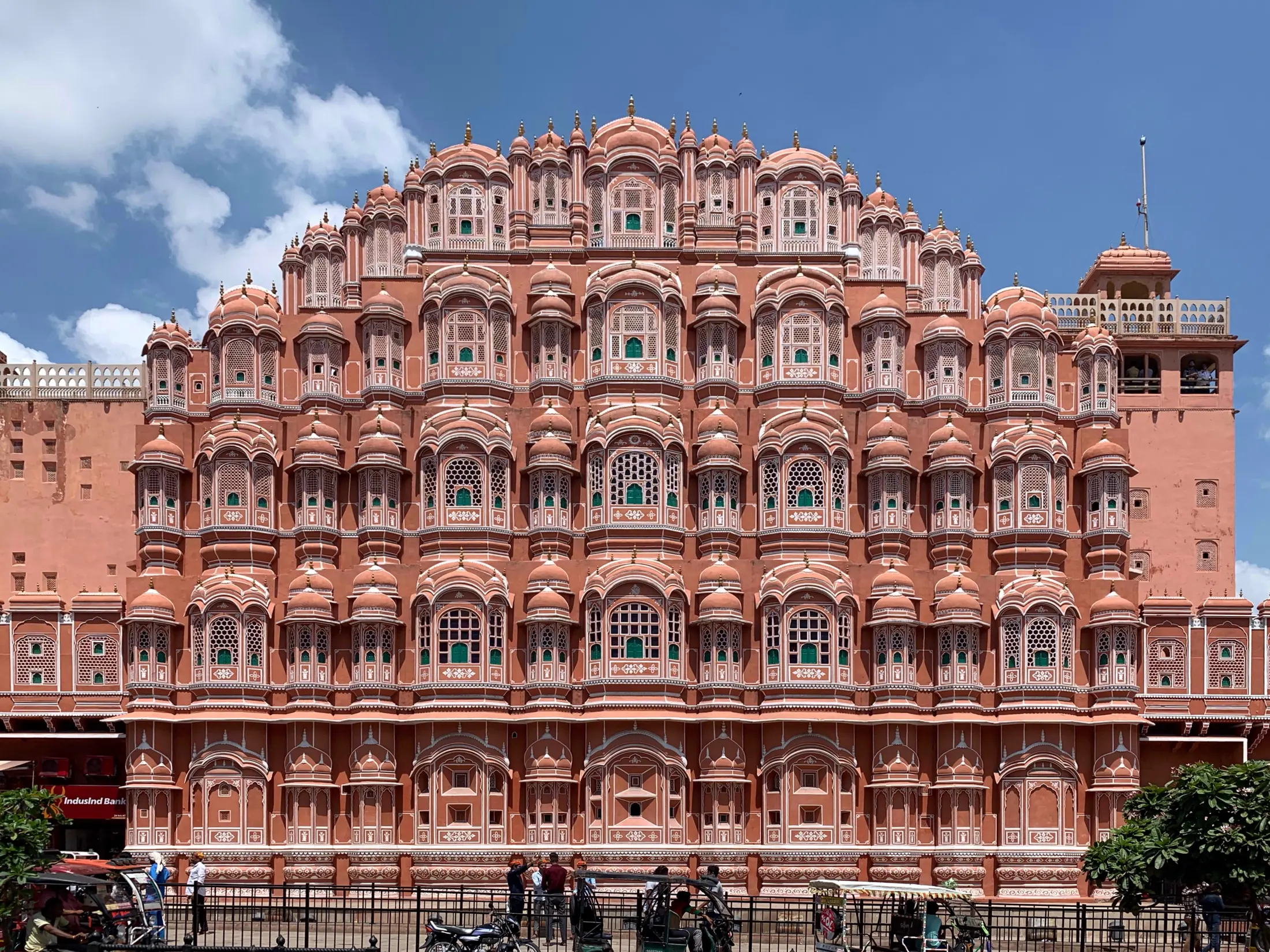
Familiar details: pink sandstone, curved Bengal-style roofs, domed chhatris, carved pillars and brackets, and projecting windows.
- Paid for by
- Courtiers and nobles of the Jaipur court
- Stone
- Pink sandstone
- Roofs
- Curved Bengal-style, with chhatris
- Walls
- Painted scenes of Ram and Krishna
- The difference is the setting: instead of a city square, the buildings cling to the walls of a gorge, rising in tiers so every pavilion looks down onto a tank.
- Painted walls: many temples and halls were painted inside and out with scenes from the lives of Ram and Krishna, flowers, birds and decorative bands.
- What survives: much has faded or flaked with time, sun and damp, but sheltered corners are still bright, and conservation work has been done in places.
- For fresco lovers: guests who love the painted havelis of Shekhawati often find these walls a revelation.
- Water engineering: the builders shaped the gorge into a chain of basins, each spilling into the next, turning a small flow into deep, still pools.
- Old water wisdom: the same you see in the region's stepwells and in the tanks of Jaigarh above Amer.
The monkeys of Galta

Who they are: rhesus macaques, brown-gold, quick and clever, living in large troops among the temples and on the cliffs.
Old neighbours: they have lived alongside the pilgrims for as long as anyone remembers.
Sacred meaning: for devotees of Ram, Hanuman the monkey god was Ram's greatest devotee, and many pilgrims feed them as devotion.
- Species
- Rhesus macaques
- Why revered
- Hanuman, Ram's greatest devotee
- Risks
- They snatch food, bags, sunglasses
- Our rule
- Watch, don't feed
- On screen: the troops of Galta have even been the subject of a wildlife documentary series.
- Wonderful to watch: mothers with babies clinging underneath, young males leaping between roofs, old matriarchs dozing in the sun.
- But wild and bold: they snatch food, bags and sunglasses, and can bite if frightened or cornered.
- Stay safe: carry nothing that looks like food, keep bags closed, and don't stare at or approach the monkeys, especially mothers.
- Why we don't feed them: food from people makes the animals more aggressive and less healthy. Watching them live their own lives is the better experience.
- Our approach: see ethical animal encounters, and wildlife around the temples for other places where monkeys and people share sacred ground.
Pilgrims, sadhus and the great bathing day
An ordinary morning: families bringing elders for a dip, women with offerings of flowers and sweets, priests tending the shrines.
The sadhus: wandering holy men sit by the water or in a pavilion's shade. Some have come for decades, some are passing through on long pilgrimages across India.
Conversation or solitude: many are glad to talk if your guide introduces you. Others prefer to be alone, and that should be respected.
- Great day
- Makar Sankranti, 14 January
- What happens
- A holy dip in Galta Kund before dawn
- Monsoon
- Picnics as well as prayer
- Ordinary days
- Calm at dawn
- The great day: Makar Sankranti, on 14 January, when the sun enters Capricorn and the days begin to lengthen.
- Before dawn: thousands walk over the ridge to bathe in Galta Kund, then return to the city to fly kites all day.
- Not for crowd-haters: it is crowded, joyful and deeply devout.
- Other days: further Hindu festival days bring pilgrims too, and in the monsoon, when the hills are green and the water runs strongly, families come for picnics.
- How we do festivals: we go early, with a guide from the old city who knows the customs, and find a quiet place to watch rather than join the press at the water's edge.
- Every other day: outside the festivals, the dawn hours are calm enough for anyone.
The best hour, and the best season

First light: walk over the ridge as the sun rises behind the Surya Mandir and lights the city below.
Down in the gorge: morning rituals are under way, the light is just reaching the water and the air is cool.
- Best hour
- First light, over the ridge
- Leave by
- About two hours later
- Best season
- October to March
- Most beautiful
- The monsoon, July to September
- Hot months
- Only very early
- When to leave: two hours later the sun is high, the stone is warming and the visitors are arriving.
- October to March: the most comfortable season, with crisp mornings and clear air.
- December and January: cold dawns, so bring a shawl.
- April to June: the ridge walk only works very early, and the gorge is hot by mid-morning.
- The monsoon: green hills, strong springs and full tanks make Galta its most beautiful, but paths can be slippery after rain.
- Winter afternoons: the light glows on the pink stone, though the monkeys are often most active then.
How to visit with respect
Dress modestly: shoulders and knees covered, with a light scarf. Our guide to what to wear in temples has more.
Shoes off: before shrines and temple platforms. Wear shoes that slip off easily and carry socks for the hot stone.
- Dress
- Shoulders and knees covered, a scarf
- Shoes
- Slip-ons, plus socks for hot stone
- Photography
- Ask first, never bathers
- Easier access
- The road entrance, valley side
- Photography: ask before photographing people, and never photograph pilgrims bathing. Architecture and views are fine.
- Monkey-proof: carry nothing that looks like food and keep bags zipped. Sunglasses and phones in hands are tempting.
- Mobility: the ridge path is steep, and the temple area has many steps and uneven, sometimes wet, stone. The valley-side road entrance is easier. See accessible travel.
- Take a guide: one who knows the temples and customs explains rituals, introduces you to priests and keeps the monkeys at a polite distance.
- Offerings: flowers or a donation in a temple box are welcome, never required. Ignore anyone who insists on payment for a blessing. See temple etiquette.
What most visitors miss
The sunrise over the city
- Why stop: the dawn view from the Surya Mandir is one of the finest in Jaipur, and almost nobody sees it.
- How: walk up from the city side and share it with pilgrims rather than tourists.
The painted walls
- Where: faded murals in the pavilions and temple walls, best in sheltered corners.
- Ask your guide: to point out scenes from the lives of Ram and Krishna.
The sound of the gorge
- How: stand still by one of the tanks for a few minutes.
- What you'll hear: bells, chanting, water and monkeys echoing off the rock, the most peaceful sound in the city.
A conversation with a priest
- How: with your guide's introduction, sit a while with a priest or sadhu.
- Why: many are happy to explain the valley's stories, and the conversation often becomes the memory guests treasure most.
A dawn at Galta, hour by hour
Before sunrise, the ridge path
In the dark: your chauffeur drops you at the foot of the ridge path on the eastern side of the old city.
- The climb: walk up with your guide as the sky lightens, pilgrims passing with brass pots and flowers.
- At the top: reach the Surya Mandir as the sun clears the hills, the city at your feet and the temple bell ringing behind you.
Early morning, the temples and the tanks
Descend as the rituals begin: spend an hour among the temples and tanks.
- What to do: watch the bathers from a respectful distance, meet a priest and look at the painted pavilions in the first light.
- Hands free: keep your bag closed, and let the monkeys go about their business.
Mid-morning, a garden and breakfast
Garden or hotel: meet your chauffeur at the valley entrance and drive to the Sisodia Rani garden for a walk among its terraces, or back to your hotel for a late breakfast.
- Before nine: you will have seen more of the real Jaipur than most visitors see all day.
- Fitting it in: our Jaipur itinerary guide shows how, and a Jaipur morning describes the city at this hour.
Sights to pair with Galtaji
Sisodia Rani garden
What it is: a terraced garden and palace laid out in 1728 by Sawai Jai Singh II for his Sisodia queen, a princess from Udaipur.
- Where: on the Agra road east of the city.
- What to see: painted walls with scenes of Krishna, and fountains and terraces climbing the hill. Visit after Galta in the morning.
Vidyadhar garden
- What it is: a formal garden nearby, named after Vidyadhar Bhattacharya, the architect who helped Jai Singh plan Jaipur.
- Why go: quiet, green and a pleasant place to sit after the climb.
The walled city
- Close by: Galta is near the eastern side of the old city.
- A full morning: over the ridge at dawn, then down to Hawa Mahal and the City Palace, with breakfast in the bazaar in between.
Other sacred places
- Go further: if Galta moves you, Rajasthan has many more sacred places.
- Where to start: our temples and pilgrim towns page and the sacred Rajasthan journey, which includes Pushkar.
Where to stay close by
Samode Haveli
- Where: a nobleman's haveli in the north-eastern quarter of the walled city, one of the closest luxury stays to the ridge path.
- Why stay: walk out before dawn, and be back for breakfast on the terrace.
The Oberoi Rajvilas
- Where: wide grounds on the eastern outskirts, a short drive to the valley entrance.
- Why stay: its own restored Shiva temple, and a calm that suits a spiritual morning.
Rambagh Palace
- Where: the former royal residence, further south but an easy drive at dawn.
- Compare: our guide to luxury hotels in Jaipur covers every option.
Who will love Galta, and who won't
Seekers, photographers and walkers: travellers interested in living faith will find it unforgettable, especially at dawn.
Families: older children enjoy the monkeys and the walk. With small children, take the road entrance and keep it short.
- Nervous of monkeys? Come with a guide, stay close and keep to the main paths. The animals are bold but usually ignore people who carry nothing.
- Dislike crowds? Avoid festival days and late mornings.
- Need polish? This is not the place. Paths are worn, the tanks are working sacred water rather than ornamental pools, and some corners are untidy. That is the honesty of a place in daily use.