खम्मा घणी Khamma ghani, a Rajasthani welcome
Blue-washed houses of Jodhpur's old city spreading below the walls of Mehrangarh Fort
Photo: Nico Crisafulli from USA, CC BY 2.0, via Wikimedia Commons
राजस्थान

Rajasthan, kingdom by kingdom

Ask a Rajasthani where they are from and they rarely name a district. They say Marwar, Mewar or Dhundhar, the names of kingdoms that were folded into one state more than seventy years ago. We plan journeys the same way, because the old borders still tell you what you'll eat, hear and see.

The map, region by region

We plan by region rather than by city, because that's how the land works: each old kingdom has its own colour, food and rhythm.
ढूंढाड़

Dhundhar and Jaipur

The Kachwaha kingdom of the eastern Aravallis: Jaipur and Amer, Samode's painted palace, the Abhaneri stepwell, Sambhar's flamingos, Alwar, and the holy towns of Pushkar and Ajmer.
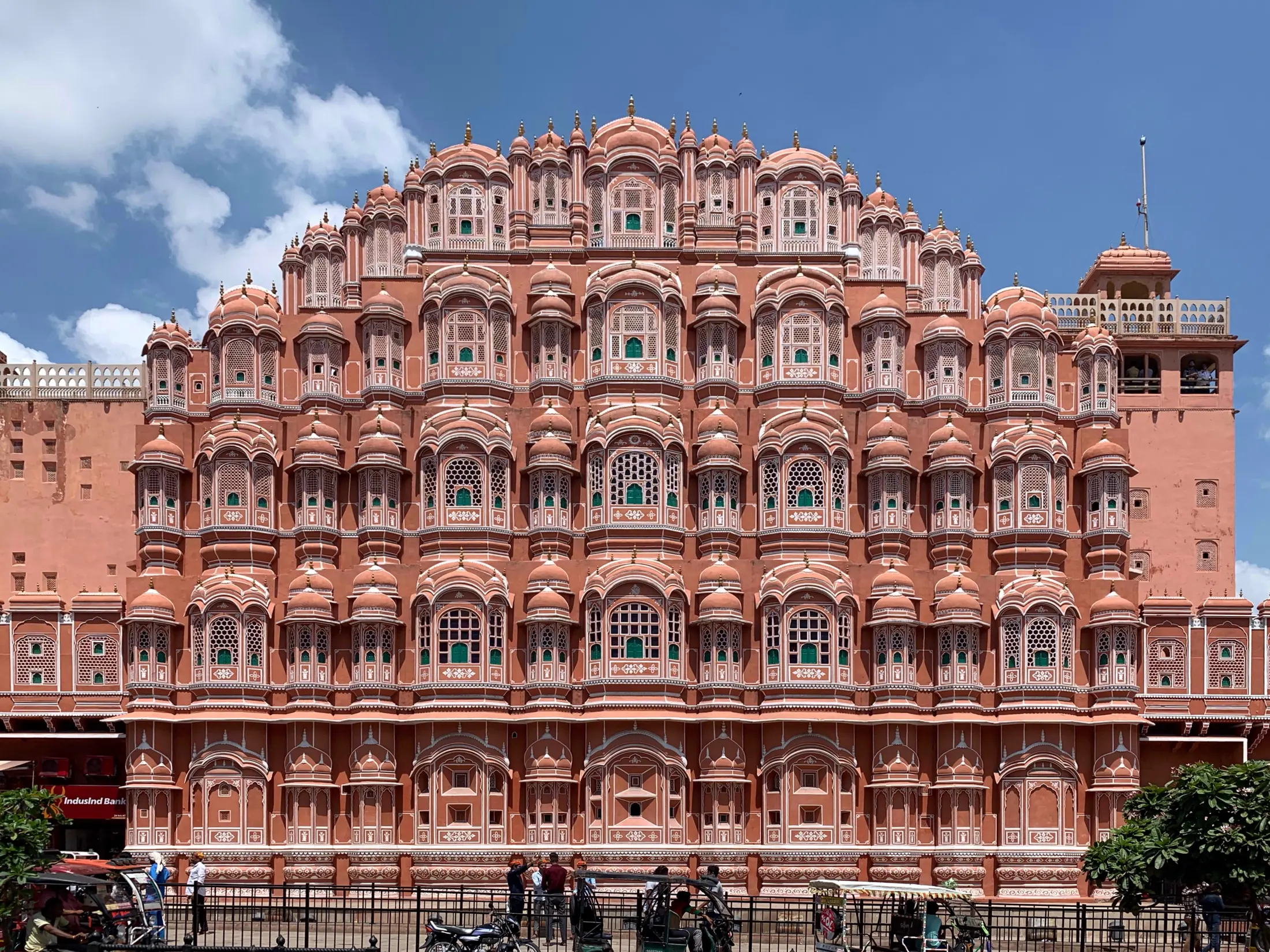
  • The rose-pink facade of Hawa Mahal rising above Siredeori Bazaar in Jaipur's walled city
    जयपुर

    Jaipur

    The Pink City, laid out in 1727 on a grid of nine squares. Amber at first light, bazaars sorted by trade, and the palace where the royal family still lives.
  • Amber Fort's ramparts and palaces rising above Maota Lake in the Aravalli hills at Amer
    आमेर

    Amer and Nahargarh

    The old Kachwaha capital in a fold of the Aravallis. Amber Fort above Maota Lake, Jaigarh and Nahargarh on the ridge, a geometric stepwell and the lanes of a temple town.
  • Cusped arcades around a courtyard of Samode Palace in the Aravalli hills
    सामोद

    Samode

    An hour from Jaipur, a nobleman's palace climbs a hillside above a farming village. Painted halls, a mirrored room, a garden camp and the quiet Aravalli countryside around it.
  • The zigzag flights of steps of Chand Baori descending thirteen storeys to the green water at Abhaneri
    आभानेरी

    Abhaneri

    A village on the Jaipur to Agra road with one of India's deepest stepwells. Chand Baori drops about 30 metres in 3,500 steps, beside the carved ruins of Harshat Mata.
  • Shallow brine and white salt flats stretching to the horizon at Sambhar Lake at sunset
    सांभर

    Sambhar Lake

    India's largest inland salt lake, a short drive west of Jaipur. Flamingos in winter, salt pans raked by hand, a goddess's legend and sunsets on a mirror of white.
  • The ruined palace of Bhangarh rising in tiers against the Aravalli hills
    भानगढ़

    Bhangarh

    A walled town of the Amber kings, abandoned for more than two centuries at the edge of Sariska. Ruined bazaars, carved temples, a palace on the hill and India's best-known ghost story.
  • A wide inner view of the City Palace at Alwar
    अलवर

    Alwar

    A princely capital in the Aravallis, three hours from Delhi. A palace and marble cenotaph beside a sacred tank, a ridge fort, a lake palace at Siliserh and tigers at Sariska.
  • The whitewashed ghats and temples of Pushkar stepping down to the sacred lake
    पुष्कर

    Pushkar

    A small holy town around a sacred lake, with 52 ghats, one of India's very few Brahma temples, dawn on Savitri hill and, in the month of Kartik, the great camel fair.
  • The white dome and courtyards of Ajmer Sharif Dargah crowded with pilgrims
    अजमेर

    Ajmer

    The city of Khwaja Moinuddin Chishti, whose dargah draws pilgrims of every faith. Chauhan lakes, a twelfth-century mosque, Mughal pavilions, a princes' school and Pushkar fifteen kilometres away.
  • The front walls and gateway of Kishangarh Fort
    किशनगढ़

    Kishangarh

    A small Rathore capital on a lake, where an eighteenth-century poet-king and his beloved inspired the Bani Thani paintings. Today it is also one of India's great marble markets.
मारवाड़

Marwar and Jodhpur

The Rathore heartland west of the Aravallis: Jodhpur below Mehrangarh, Osian's temples, country forts at Khimsar, Rohet and Manvar, Nagaur's great fair and the red city of Bikaner.
  • Blue-washed houses of Jodhpur's old city crowding the hillside below the ramparts of Mehrangarh Fort
    जोधपुर

    Jodhpur

    The Rathore capital, founded in 1459 beneath the cliff-top fort of Mehrangarh. Blue lanes, a clock-tower bazaar, a living Art Deco palace and the best mirchi bada in Rajasthan.
  • Carved sandstone temple spires of the ancient temple group at Osian in the Thar desert
    ओसियां

    Osian

    An ancient caravan town north of Jodhpur with some of Rajasthan's oldest temples, a hilltop goddess who belongs to Jains and Hindus alike, and sand dunes at sunset.
  • Sunset light over the dunes of the Thar desert
    खींवसर

    Khimsar

    A fort built in 1523 by a son of Jodhpur's founder, on the eastern edge of the Thar. Ramparts at sunset, a dune village nearby and blackbuck grazing in the fields.
  • Rippled sand dunes and scattered desert shrubs in the Thar between Jodhpur and Jaisalmer at sunset
    मनवार

    Manvar

    Halfway between Jodhpur and Jaisalmer, a family's desert camps among the dunes of Shergarh. Jeeps at sunset, village walks, Manganiyar music by the fire and a sky crowded with stars.
  • A black Marwari stallion with the breed's inward-curving ears
    रोहट

    Rohet

    A village south of Jodhpur where one family has lived since 1622. A lakeside fort where famous books were written, Marwari horses at dawn and Bishnoi villages that guard the blackbuck.
  • The walls and palace buildings of Ahhichatragarh, the fort of Nagaur, in the Thar desert
    नागौर

    Nagaur

    A desert town between Jodhpur and Bikaner with a twelfth-century fort, superbly restored, painted queens' palaces, a Sufi shrine and one of India's great winter cattle fairs.
  • The red sandstone walls and balconied palaces of Junagarh Fort in Bikaner
    बीकानेर

    Bikaner

    Founded in 1488 by a son of Jodhpur's founder, Bikaner has a fort that was never taken by siege, merchants' havelis of carved red stone, camels everywhere and the famous bhujia.
माड

Maad, Jaisalmer and the Thar

The Bhati kingdom of the deep Thar: Jaisalmer's living golden fort, carved merchant havelis, the dunes of Sam and Khuri, ghostly Kuldhara and the crafts and music of Barmer.
  • The yellow sandstone walls and bastions of Jaisalmer Fort rising from Trikuta hill above the town
    जैसलमेर

    Jaisalmer

    A twelfth-century sandstone fort where about four thousand people still live, merchant havelis carved like lace, Manganiyar singers at dusk and the dunes of the Thar an hour away.
  • Wind-rippled golden sand dunes at Sam in the Thar Desert near Jaisalmer in low evening light
    सम

    Sam Sand Dunes

    The great dunes forty kilometres west of Jaisalmer. Glorious at dawn, crowded at sunset. We show you how to ride camels kindly, choose the right camp and find a ridge of your own.
  • Low rolling sand dunes at Khuri in the Thar Desert southwest of Jaisalmer, with scattered desert shrubs
    खुड़ी

    Khuri

    A desert village of mud-plastered houses southwest of Jaisalmer, with low, rolling dunes and far fewer visitors than Sam. Come for slow evenings, village life and a sky full of stars.
  • Roofless sandstone houses lining a straight street in the abandoned village of Kuldhara near Jaisalmer
    कुलधरा

    Kuldhara

    A deserted medieval township of Paliwal Brahmin farmers southwest of Jaisalmer, and the ruined hill fort of Khaba beyond it. Forget the ghost stories. The real history is far more interesting.
  • The carved sandstone Someshvara temple at Kiradu standing in the desert near Barmer
    बाड़मेर

    Barmer

    The craft heartland of the Thar, south of Jaisalmer. Embroidery and appliqué villages, ajrakh printers, the ruined eleventh and twelfth-century temples of Kiradu, and the music of the Langas and Manganiyars.
मेवाड़

Mewar and Udaipur

The Sisodia kingdom of the southern Aravallis: Udaipur's lake palaces, the walls of Kumbhalgarh, Ranakpur's marble halls, Chittorgarh, Nathdwara, quiet Dungarpur and Banswara, and Mount Abu.
  • The long cream facade of Udaipur's City Palace rising above the still water of Lake Pichola
    उदयपुर

    Udaipur

    The lake city of Mewar, founded in 1559. The City Palace above Lake Pichola, a palace hotel floating on the water, painted lanes, sunset boats and the calmest evenings in Rajasthan.
  • Kumbhalgarh's massive fort wall and round bastions snaking over the green Aravalli hills
    कुम्भलगढ़

    Kumbhalgarh

    A fifteenth-century mountain fortress whose wall runs about 36 kilometres over the Aravalli ridges. The birthplace of Maharana Pratap, ringed by a forest sanctuary of wolves and leopards.
  • The pale marble domes and spires of the Ranakpur Jain temple rising from a wooded valley
    रणकपुर

    Ranakpur

    A fifteenth-century Jain temple of pale marble in a quiet Aravalli valley, raised on 1,444 carved pillars. The finest stop on the road between Udaipur and Jodhpur.
  • The carved nine-storey Vijay Stambha, the tower of victory, rising inside Chittorgarh Fort
    चित्तौड़गढ़

    Chittorgarh

    Often called India's largest fort, spread across a rock plateau high above the plains. Towers of victory and fame, Meera Bai's temple and the memory of three great sieges.
  • A pichwai painting of Shrinathji with dancing gopis, the art of Nathdwara
    नाथद्वारा

    Nathdwara

    The pilgrim town an hour north of Udaipur where Krishna is cared for as a living child. Shrinathji's brief, crowded darshans, the painters of pichwai and the lakes of Rajsamand.
  • An equestrian portrait of a Rajput noble in the Rajasthani miniature style
    देवगढ़

    Deogarh

    A Chundawat palace above a market town in northern Mewar, home of a celebrated school of miniature painting, with lakes, villages and a slow train through the Aravallis.
  • Carved marble pillars inside the Jain temple at Ranakpur, half an hour from Narlai
    नारलाई

    Narlai

    A Godwar village between Udaipur and Jodhpur, gathered around a granite hill with a white stone elephant on top, old carved temples and a royal hunting lodge.
  • Udai Bilas Palace in Dungarpur reflected in the still water of Gaib Sagar lake
    डूंगरपुर

    Dungarpur

    The town of hills in southern Rajasthan, with the seven-storey Juna Mahal and its murals, Udai Bilas Palace on Gaib Sagar lake and the green Bhil country of Vagad.
  • The Mahi Bajaj Sagar dam releasing water near Banswara
    बांसवाड़ा

    Banswara

    Rajasthan's green south, where the Mahi river breaks into islands, the goddess Tripura Sundari keeps her temple, and Bhil country spills across the borders of three states.
  • Nakki Lake seen through the trees of the Mount Abu Wildlife Sanctuary
    माउंट आबू

    Mount Abu

    Rajasthan's only hill station, a granite plateau above the plains with the marble Dilwara temples, Nakki Lake, Guru Shikhar, old Achalgarh and forests where sloth bears still roam.
हाड़ौती

Hadoti, Bundi and Kota

The land of the Hada Chauhans in Rajasthan's green south-east. Bundi's murals and stepwells, Kota on the Chambal, and Gagron, a fort wrapped by two rivers.
  • Bundi's Garh Palace stepping down the hillside above the blue and white houses of the old town
    बूंदी

    Bundi

    A Hada Rajput capital folded into a gorge, with a palace of green-and-gold murals, more than fifty stepwells and blue lanes that Kipling walked in 1887.
  • The Garh Palace of Kota with its towers and balconies above the Chambal river
    कोटा

    Kota

    The richer of the two Hada capitals, on the broad Chambal. A palace full of tiger-hunt paintings, gossamer Kota Doria saris, a vast Dussehra fair and a modern student city.
  • The long walls of Gagron Fort rising above the meeting of the Ahu and Kali Sindh rivers near Jhalawar
    झालावाड़

    Jhalawar

    Rajasthan's green south-eastern corner. Gagron, a UNESCO hill fort with rivers on three sides, the thousand-year-old temples of Jhalrapatan, orange orchards and a royal family's hunting lodge.
शेखावाटी

Shekhawati, the painted towns

The open-air gallery of the Thar's edge. Merchant havelis painted with gods, trains and motorcars in Mandawa, Nawalgarh, Fatehpur, Alsisar and Churu, a few hours from Jaipur and Delhi.
  • The bastions and painted gateway of Castle Mandawa above the rooftops of Mandawa town
    मंडावा

    Mandawa

    A castle built in 1755 to guard a caravan post, and lanes of merchant havelis painted with gods, trains and aeroplanes. Shekhawati's best base, and its most cinematic town.
  • The painted gateway and facade of the Dr Ramnath A Podar Haveli Museum in Nawalgarh
    नवलगढ़

    Nawalgarh

    Founded in 1737 by Thakur Nawal Singh, home town of great Marwari business families, and the place to see Shekhawati's paintings properly restored, in two haveli museums.
  • A painted mural of Shiva behind a lingam with two devotees on a haveli wall in Fatehpur
    फतेहपुर

    Fatehpur

    The oldest of the painted towns, founded by a Kaimkhani nawab in the fifteenth century. Home of the Le Prince haveli, the mansion a French painter bought and brought back to life.
  • A painted wall in a Shekhawati haveli, the fresco art that fills the towns around Alsisar
    अलसीसर

    Alsisar

    A Shekhawat thakur's fort, shelled by the British in 1834 and restored as a heritage hotel in 2006, in a quiet farming village of painted havelis in Jhunjhunu district.
  • The tall, many-windowed facade of the Surana Haveli rising above a lane in Churu
    चूरू

    Churu

    A Bikaner frontier town on the edge of the Thar, with towering merchant havelis, a fort famous for its silver cannonballs, a famine-era reservoir and sand dunes at the end of the street.
वन्य राजस्थान

Wild Rajasthan

Tigers in a ruined fort at Ranthambore, leopards on Jawai's granite hills, wetlands at Bharatpur, blackbuck at Tal Chhapar and the bustards of the Thar, guarded by a 500-year-old conservation faith.
  • A Bengal tiger yawning in the forest of Ranthambore National Park
    रणथंभौर

    Ranthambore

    India's most famous place to see a wild tiger, in dry forest around lakes, ruined pavilions and a UNESCO-listed hill fort. Safaris at dawn, a Ganesh temple and fine jungle lodges.
  • An Indian leopard resting on a granite boulder in the hills around Jawai Bandh
    जवाई

    Jawai

    Granite hills between Udaipur and Jodhpur where leopards share caves, temples and grazing land with Rabari herders, above a great reservoir full of crocodiles and winter birds.
  • Shallow wetland pools and acacia trees at Keoladeo National Park, Bharatpur, in winter morning light
    भरतपुर

    Bharatpur and Keoladeo

    A UNESCO wetland where Maharajas once shot ducks and painted storks now nest, a mud fort that held off the British in 1805, and the fountained palaces of Deeg nearby.
  • Dry Aravalli hills and dhok forest stretching across Sariska Tiger Reserve in Alwar district
    सरिस्का

    Sariska

    An Aravalli forest four hours from Delhi that lost every tiger and won them back. Hilltop forts, ruined temples, a Hanuman shrine in a gorge and Bhangarh down the road.
  • A male blackbuck with long spiralled horns standing in the golden grass of Tal Chhapar sanctuary
    ताल छापर

    Tal Chhapar

    A former royal hunting reserve of Bikaner, now a small, flat grassland where blackbuck herds spar at dawn and harriers, eagles and demoiselle cranes stop on their migration.
  • A great Indian bustard walking through dry grassland in the Desert National Park near Jaisalmer
    मरु राष्ट्रीय उद्यान

    Desert National Park

    More than three thousand square kilometres of Thar grassland, dune and rock near Jaisalmer. The last stronghold of the great Indian bustard, with chinkara, desert foxes, wintering eagles and Jurassic fossils.
राजस्थान के पार

Beyond Rajasthan

The Taj Mahal and Fatehpur Sikri, Delhi's Mughal city, the white Rann of Kutch, the temples of Khajuraho and Orchha, Gwalior's fort and Varanasi's ghats, all closer to Rajasthan than maps suggest.
  • The white marble Taj Mahal and its four minarets reflected in the long water channel of the garden
    आगरा

    Agra

    The Mughal capital on the Yamuna, four hours from Jaipur. The Taj Mahal at first light, Akbar's red fort, the jewel-box Baby Taj and a sunset garden across the river.
  • The towering red sandstone Buland Darwaza gateway at Fatehpur Sikri seen from the steps below
    फ़तेहपुर सीकरी

    Fatehpur Sikri

    Akbar's red sandstone capital on a ridge west of Agra, lived in for barely fifteen years. A towering victory gate, a saint's marble tomb and palaces that still feel inhabited.
  • The red sandstone and white marble dome of Humayun's Tomb rising above its Mughal garden in Delhi
    दिल्ली

    Delhi

    Where most Rajasthan journeys begin. Mughal Old Delhi, Lutyens' avenues, Humayun's garden tomb and the Qutub Minar, with grand hotels to land in and a gentle first night.
  • The flat white salt crust of the Great Rann of Kutch at Dhordo stretching to the horizon
    कच्छ

    Kutch

    India's largest district, a salt desert that turns white in winter. Full moons on the Rann, embroidered villages of mud houses, Bhuj's mirrored palace and the Harappan city of Dholavira.
  • The carved stone lattice of intertwined trees in the window of the Sidi Saiyyed Mosque in Ahmedabad
    अहमदाबाद

    Ahmedabad

    India's first UNESCO World Heritage City, a sultan's capital of carved wooden pols and stone lattices. Stepwells at Adalaj and Patan, Gandhi's ashram, great textile museums and a thali to remember.
  • The domed corner towers of Jahangir Mahal rising above the fort complex at Orchha
    ओरछा

    Orchha

    The Bundela capital on a bend of the Betwa. Painted palaces, a temple where Rama rules as king, and royal chhatris where vultures still nest at dusk.
  • The rising spires of the Kandariya Mahadeva temple in the Western Group at Khajuraho
    खजुराहो

    Khajuraho

    A thousand years of sandstone in a Bundelkhand village. The Chandela temples explained with care, Jain shrines still in worship, the February dance festival and tigers in Panna.
  • The towers and blue-tiled walls of Man Mandir palace along the cliff of Gwalior Fort
    ग्वालियर

    Gwalior

    A three-kilometre sandstone fort crowned by a tiled palace, temples from the ninth century, the Scindias' Jai Vilas and the tomb of Tansen. A UNESCO City of Music since 2023.
  • The stepped ghats and riverside palaces of Varanasi along the Ganga in the early morning light
    वाराणसी

    Varanasi

    Kashi, Shiva's city on the Ganga. Dawn by rowing boat past eighty-odd ghats, lamps at the evening aarti, the lanes, Banarasi silk looms, Sarnath, and a palace on the river.
  • The sandstone pavilions of Keshi Ghat on the Yamuna river at Vrindavan
    मथुरा वृंदावन

    Mathura and Vrindavan

    Krishna's own country on the Yamuna. Vrindavan's temples at dawn, the stick-and-colour Holi of Barsana and Nandgaon, the Govardhan parikrama, and a living faith to visit gently.

A state made of kingdoms

Our grandfather was born a subject of the Maharaja of Jaipur and died a citizen of the Republic of India. Rajasthan is young as a state, and very old as a set of kingdoms.
The golden sandstone walls and bastions of Jaisalmer Fort rising from Trikuta hill
Photo: Clément Bardot, CC BY-SA 4.0, via Wikimedia Commons

Rajputana: before 1947 there was no Rajasthan on the map. The British called the region the land of the Rajputs.

A patchwork: some two dozen princely states, each with its own ruler, coinage, courts and customs.

Ajmer: in the middle, governed directly by the British.

Facts to know
Old name
Rajputana
Princely states
Some two dozen
Tod's Annals
1829 and 1832
Rajasthan Day
30 March, from 1949
Merger completed
1956
Privy purses ended
1971
  • The name: James Tod of the East India Company gave Rajasthan its wide currency in his Annals and Antiquities of Rajasthan. He got a great deal wrong, but he loved the place, and the name stuck.
  • Merged in stages: Jaipur, Jodhpur, Bikaner and Jaisalmer joined in 1949, which is why 30 March is Rajasthan Day.
  • Kings without thrones: the rulers lost their thrones, and in 1971 their privy purses.
  • Palaces become hotels: many families turned their palaces into hotels and museums, which is why you can sleep in rooms built for a maharaja.
  • Still in people's heads: a wedding follows the customs of its clan, and a village's dialect tells you which court it once paid taxes to.
  • Sun, moon and fire: the great Rajput houses traced their lines to one of the three. They intermarried, feuded, allied with the Mughals or defied them.
  • Six UNESCO forts: Chittorgarh, Kumbhalgarh, Ranthambore, Gagron, Amber and Jaisalmer, inscribed together in 2013 as the Hill Forts of Rajasthan.
  • Read more: the Rajput dynasties and a short history of Rajasthan.

The regions, and what each one feels like

Each of these was once a court with its own taste. Here is the character of each, in the order we usually travel them.

Dhundhar, Jaipur's country

The Kachwaha kingdom: of the eastern hills, ruled from Amer and then Jaipur.

  • Its character: pink bazaars, gem-cutters, block-printers and the stepwell at Abhaneri, and where most journeys begin.
  • Its western edge: the holy lake at Pushkar, the Sufi shrine at Ajmer and the painting town of Kishangarh.
Read our guide to Dhundhar

Marwar, the Rathore heartland

  • West of the Aravallis: the land flattens into scrub, and the Rathores built Jodhpur and Bikaner.
  • Its character: blue houses below Mehrangarh, Bishnoi villages where blackbuck graze, country forts turned family hotels, and the best breakfast kachori in the state.
Read our guide to Marwar

Maad, Jaisalmer and the Thar

  • The Bhati kingdom of the deep desert: a golden fort people still live inside, merchant havelis carved like lace, and dunes at Sam and Khuri.
  • Its character: Manganiyar singers and the clearest sky in India.
Read our guide to Maad and the Thar

Mewar, the lakes and the Sisodias

The proudest house: the Sisodias ruled the green southern hills from Chittorgarh, then Udaipur.

  • Its character: lake palaces, the great wall of Kumbhalgarh, Ranakpur's marble halls and the pilgrim town of Nathdwara.
  • Who asks first: it is the region couples want most.
Read our guide to Mewar

Hadoti, Bundi and Kota

Hada Chauhan country: the south-east, watered by the Chambal.

  • Bundi: the most painted and least hurried of the old capitals, with stepwells in its lanes and murals in its palace.
  • Our view: most travellers drive straight past it, and that is a mistake.
Read our guide to Hadoti

Shekhawati, the painted towns

  • North of Jaipur: the Shekhawat clan's land became home to merchant families who made fortunes elsewhere and spent them on frescoed havelis at home.
  • Open-air galleries: Mandawa, Nawalgarh and Fatehpur, best seen slowly over two or three nights.
Read our guide to Shekhawati

Wild Rajasthan

  • A theme, not a kingdom: Ranthambore's tigers, Jawai's leopards, Bharatpur's wetland birds, Tal Chhapar's blackbuck and the Desert National Park's bustards.
  • Why they survive: most were once royal hunting reserves.
Explore wild Rajasthan

Beyond Rajasthan

  • Just over the border: Agra, Delhi, Kutch, Orchha, Khajuraho and Varanasi pair naturally with Rajasthan.
  • Close links: the Taj Mahal is a five-hour drive from Jaipur, and Kutch's salt desert continues the Thar into Gujarat.
See places beyond Rajasthan

One mountain range, one desert

Fly from Delhi to Udaipur on a clear winter morning and you'll see the whole logic of Rajasthan from the window: a long spine of worn hills, sand to the west of it and fields to the east.

The Aravallis: running diagonally from near Mount Abu in the south-west to near Delhi in the north-east.

Among the oldest ranges on earth: worn over hundreds of millions of years into low, rocky ridges.

They catch the monsoon: so Mewar and Hadoti to the south and east are green, with lakes, forests and rivers.

Facts to know
Area
About 342,000 sq km
Mountain range
The Aravallis
Highest point
Guru Shikhar, about 1,722 m
Desert
The Thar, over half the state
  • They hold the forts: Amber, Kumbhalgarh and Chittorgarh all sit on Aravalli ridges.
  • The Thar: the Great Indian Desert covers more than half of Rajasthan and runs on into Pakistan.
  • Not an empty sea of sand: mostly scrub, rock and farmland that greens briefly after the rains, with khejri trees, villages and herds of goats and camels.
  • Where the dunes are: in pockets, mainly around Jaisalmer and Bikaner.
  • Desert people: Marwar and Maad built for heat, stored every drop in stepwells and tanks, and became north-west India's great traders and caravan merchants.
  • Water is the thread: the stepwells of Abhaneri and Bundi, Udaipur's lakes and the tanks inside Jaisalmer Fort all held on to a short monsoon.
  • Read more: the stepwells of Rajasthan explains how they worked.

How to choose where to go

The first question we ask is never where you want to go. It's how you like to spend an afternoon.

Too large for one journey: trying to see it all is the most common mistake we see.

  • The scale: a road trip from Bikaner in the north to Banswara in the south takes the better part of two days.
  • Our rule: choose two or three regions, give each enough nights, and leave space between the long drives.

For a first journey

Jaipur, Jodhpur and Udaipur: Dhundhar, Marwar and Mewar, each with palace hotels among India's finest.

For couples

  • Mewar first: a lake palace in Udaipur, a hilltop fort such as Deogarh, and a stepwell dinner in Narlai.
  • Then the desert: a camp near Jaisalmer for a night under the stars. See Rajasthan honeymoons.

For families

  • What children love: forts with real cannons, camel carts, puppet shows and tiger safaris.
  • Short drives: Jaipur, Ranthambore and Udaipur, with a desert camp usually the highlight. See family journeys in Rajasthan.

For culture and craft

  • Dhundhar and Shekhawati: block printing, blue pottery, gem-cutting and painted havelis.
  • Marwar: Bishnoi villages, weavers and potters. The textile and craft trail links the best workshops.

For those who have been before

  • Where the coaches don't go: Bundi, Chittorgarh, Dungarpur, Banswara, Nagaur and Marwar's country forts.
  • Our own friends' route: see offbeat Rajasthan.

Sample routes through the kingdoms

These are the shapes we draw most often on the map with a pencil. Each can be slowed down, and we usually suggest you do.
The City Palace of Udaipur and the Mohan temple reflected in Lake Pichola
Photo: Jakub Hałun, CC BY-SA 4.0, via Wikimedia Commons
Facts to know
First journey
Ten to fourteen nights
One week
Dhundhar and Mewar
Ten days
Jaipur, Jodhpur, Udaipur
Longest drive
About six hours on the ten-day route

One week, Dhundhar and Mewar

  • The shape: three nights in Jaipur, a night at Deogarh or Chittorgarh on the way south, and three in Udaipur.
  • Why it works: the gentlest introduction, two great cities and a fort between. See one week in Rajasthan.

Ten days, the classic triangle of kingdoms

  • The shape: Jaipur for three nights, Jodhpur for two, a night at Rohet or Narlai, then Udaipur for three, via Ranakpur.
  • Why it works: Dhundhar, Marwar and Mewar seen properly. See Rajasthan in ten days.

Two weeks, with the desert

  • The shape: add Jaisalmer and a night on the dunes between Jodhpur and Udaipur, or fly out of Jaisalmer at the end.
  • Our version: the Royal Rajputana journey, from the pink city to the golden one.

The desert triangle

  • The shape: Jodhpur, Jaisalmer and Bikaner, with country forts at Khimsar and Manvar.
  • Who it suits: lovers of empty horizons, camels and music. See our desert triangle journey.

Palaces and wildlife

  • The shape: Jaipur, Ranthambore for tigers, Bundi for murals and Udaipur for lakes, perhaps with Jawai for leopards.
  • Who it suits: families and photographers. See Palaces and Tigers.

Seasons across the regions

In January our cousins in Jaisalmer sleep under three quilts, while Udaipur still has lunch in the garden. The seasons are the same across Rajasthan, but they don't land the same way everywhere.

October: warm afternoons, with Mewar's lakes full and its hills green after the monsoon.

Deep winter: near Jaisalmer and Bikaner, temperatures can drop close to freezing before dawn. Pack a warm layer for every early start.

Facts to know
Travelling season
October to March
Most comfortable
November and February
Coldest nights
December and January
Hot months
April to June
Monsoon arrives
Late June or July
  • Summer: often past 40°C in the plains and higher in the Thar.
  • Mount Abu: the only hill station, and always the summer refuge. Palace hotels are quiet and generous then.
  • Monsoon: best in Mewar and Hadoti, when Udaipur's lakes fill and the Aravallis turn green. It is the season of Teej and almost empty palaces.
  • Month by month: our best time to visit Rajasthan guide.

Festivals that shape the calendar

Makar Sankranti: kites fill the sky over Jaipur on 14 January.

Winter fairs: the Desert Festival in Jaisalmer and the Nagaur cattle fair fall in January or February.

  • Through the year: Holi and Gangaur in spring, Teej in the monsoon, and Diwali in October or November.
  • Pushkar: the Pushkar Camel Fair gathers around the Kartik full moon in October or November.
  • Every festival: our festival calendar.

Getting between the kingdoms

Rajasthan is a road-trip state. The drives between the old capitals are part of the pleasure, if you plan them well.

Airports: Jaipur, Udaipur and Jodhpur are best connected. Jaisalmer and Bikaner have smaller airports with fewer, sometimes seasonal, flights.

With Ranakpur: Jodhpur to Udaipur takes most of a day.

Facts to know
Jaipur to Jodhpur
Five to six hours
Jodhpur to Jaisalmer
About five hours
Jodhpur to Udaipur
About five hours
Delhi to Jaipur
Four to five hours
Jaipur to Agra
About four hours
Main airports
Jaipur, Udaipur, Jodhpur

Sleeping in the old courts

The best way to understand a kingdom is to sleep in one of its palaces. Many are still run by the families who built them.
Morning tea at a desert farmhouse near the Sam dunes in the Thar
Photo: Rudolph.A.furtado, CC0, via Wikimedia Commons

Dhundhar and Mewar: the grand palace hotels, such as Rambagh Palace in Jaipur and the Taj Lake Palace on Lake Pichola.

Marwar's palace: Umaid Bhawan Palace, the twentieth-century palace where Jodhpur's royal family still lives in one wing.

  • Marwar's country: forts and rawlas, the manor houses of the old nobility, where owners often eat with their guests.
  • Maad: desert camps, from simple luxury tents to Suryagarh, a new fort built in the old style outside Jaisalmer.
  • Matching the mood: a grand palace for the cities, a family fort for the countryside, a camp for the dunes.
  • The difference explained: palace hotels and heritage havelis, and the full list under stays.

What we tell friends before they come

A few small things make travelling between the kingdoms easier and kinder.

Don't try to see everything: three regions in ten days is plenty, and two is better.

Drive after lunch: leave every drive over four hours for the afternoon, so the best light is spent at a fort, not in the car.

  • Learn the greeting: khamma ghani across Marwar and Mewar, and ram ram sa in villages everywhere.
  • Carry a scarf: dress modestly for temples, dargahs and villages. See etiquette and dress.
  • No elephant rides: we don't book them or animal shows. Meet Rajasthan's animals in Bishnoi villages or on safari instead.
  • Eat the regional dish: laal maas in Jaipur and Jodhpur, ker sangri in the desert and maize dishes in Mewar. See our Rajasthani food guide.

Questions about Destinations

These are the questions our guests ask before they come. If yours isn't here, a planner in Jaipur will answer it within a day.

How many days do I need to see Rajasthan?

Ten to fourteen nights lets you see three or four regions without rushing, for example Jaipur, Jodhpur, Jaisalmer and Udaipur. A week is enough for two regions, such as Dhundhar and Mewar. Three weeks lets you add Bundi, Shekhawati, wildlife or the country forts of Marwar.

Which is better, Jaipur, Jodhpur or Udaipur?

They are different, and most first journeys include all three. Jaipur is the busiest and has the most sights and shopping. Jodhpur has the most dramatic fort and the bluest old city. Udaipur is the calmest and most romantic, built around its lakes. If you can only choose one, we usually suggest Udaipur for couples and Jaipur for first-timers.

What is the difference between Marwar and Mewar?

Marwar is the Rathore kingdom of the western desert, ruled from Jodhpur, and Mewar is the Sisodia kingdom of the greener southern hills, ruled from Chittorgarh and then Udaipur. They differ in landscape, dialect, food and history, and the two houses were sometimes allies and sometimes rivals. Our Mewar and Marwar journey combines both.

What is the best time to visit Rajasthan?

October to March is the best time across the state. November and February are the most comfortable months, and December and January have cold nights in the desert. The monsoon from July to September is lovely in Udaipur and Bundi, while April to June is very hot everywhere except Mount Abu.

Is Rajasthan all desert?

No. The Thar desert covers the west, around Jodhpur, Jaisalmer, Bikaner and Barmer. East and south of the Aravalli hills, Dhundhar, Mewar and Hadoti have farmland, lakes, forests and rivers, and Mount Abu is a green hill station.

Can I combine Rajasthan with the Taj Mahal?

Yes, easily. Agra is about four hours from Jaipur by road, so the Taj Mahal fits at the start or end of a Rajasthan journey, usually with Delhi. Our Rajasthan with the Taj Mahal journey shows how.

Should I travel Rajasthan by car, train or plane?

Mostly by car with a private chauffeur, because many of the best places are between the cities. Fast trains are good for Delhi to Jaipur, and short flights help on the longest legs, such as Jaisalmer to Delhi or Jaipur to Udaipur.
Written and checked by our Jaipur team, last updated 2026-10-16.
आपकी यात्रा

Tell us how you like to travel, and we'll draw you a Rajasthan

There's no booking engine and no fixed package. A planner from our Jaipur team will reply within a day with ideas, honest advice on timing and a few questions. Nothing is booked until every detail is right.
  • Reply within one working day
  • Your own planner on WhatsApp
  • No payment until you approve the plan
We use your details only to plan your journey. See our privacy policy.
खम्मा घणी

Request a call back

Leave your number and a planner from our team will call you at a time that suits you, usually within one working day.