A king who measured the sky

A boy king: Jai Singh came to the throne of Amer in 1699 and served the Mughal emperors as general, governor and diplomat for more than forty years.
Sawai: one and a quarter, a compliment from the Mughal court, meaning he was worth more than one ordinary man.
His passion: astronomy. He studied the Sanskrit texts, the Persian and Arabic tables of the Islamic astronomers, and European work through Jesuit scholars.
- Built
- Instruments by 1728, complete 1734
- Built by
- Sawai Jai Singh II
- Open
- A daytime visit
- Allow
- About ninety minutes with a guide
- Best time
- Late morning to early afternoon, in sun
- Photography
- Allowed
- Getting there
- Opposite the City Palace's Virendra Pol
- Errors everywhere: calendars drifted, eclipses came early or late, and the astrologers' tables for festivals and weddings no longer matched the sky.
- Five observatories: over roughly fifteen years he built them in Delhi, Jaipur, Ujjain, Varanasi and Mathura.
- Jaipur was the best: Mathura's has vanished and the others are smaller and more worn. Jaipur, at his own front door beside the new City Palace, was the largest and best equipped.
- Timeline: instruments were already standing here by 1728, and the observatory was substantially complete in 1734.
- A working institute: at its height it had more than twenty astronomers at work.
- Jagannatha Samrat: his court scholar translated Ptolemy's Almagest and Euclid's Elements into Sanskrit.
- The star tables: Jai Singh's Zij-i Muhammad Shahi, dedicated to the emperor Muhammad Shah, was used across India for about a century.
- Read more: our article on Sawai Jai Singh the astronomer, and our page on Jaipur for how the same mind laid out a grid of nine blocks.
Why build instruments the size of houses
Imagine the courtyard on a winter night in the 1730s, lit by a few lamps, with astronomers moving between the walls and calling numbers to a scribe.
The limits of brass: Jai Singh owned brass astrolabes. A small instrument has a small scale that can only be read so finely, and brass wears, bends and shifts.
Go big, go stone: make a sundial 27 metres tall and the hour marks spread so wide that you can read seconds. Set it in stone and mortar and it cannot drift.
- Why stone
- Bigger scales, no drift
- Precedents
- Samarkand and Maragha
- Type
- Naked-eye, not telescopes
- Aligned to
- True north and latitude 27°
- Not entirely new: great masonry observatories had stood at Samarkand and Maragha, but nobody had built so many instruments of such size in one place.
- Not telescopes: naked-eye tools for measuring angles, such as the sun's height, a star against the horizon, or when a shadow touches a mark.
- Strengths and limits: they track the sun beautifully, but are less good at faint stars. Shadows have soft edges and foundations settle.
- The debate: historians argue about how much new data they produced. Nobody argues that this is the finest surviving monument to naked-eye astronomy anywhere.
- By day: an observer followed the shadow's edge across a marble scale and called out the mark.
- By night: he lay or stood inside the instrument, lined up a star with a sighting edge or thread, and read its position.
- A team effort: several observers repeated each reading, results were compared and written into tables, and Jai Singh, by most accounts, often joined in.
- Very Jaipur: the king who planned a city by geometry wanted the sky to obey a grid too.
- Pointing at the pole: the instruments are aligned to true north and Jaipur's latitude, about 27 degrees, so the great sundial's slope points at the pole star, in effect along the earth's axis.
Instrument by instrument

- Instruments
- Nineteen, of stone, marble and bronze
- Largest
- Vrihat Samrat Yantra, about 27 metres
- Accuracy
- About two seconds on the great dial
- Jai Singh's own
- Jai Prakash Yantra
- Bronze
- Yantra Raj, about 2.4 metres across
Laghu Samrat Yantra, the small sundial
What it is: a sundial of red sandstone and marble with a triangular gnomon, the part that casts the shadow, set at Jaipur's latitude.
- Accuracy: local solar time to about twenty seconds.
- Start here: your guide shows you how to read it, so the giant version makes sense later.
- Try it: put your finger on the shadow's edge and wait. You'll see it move.
Vrihat Samrat Yantra, the supreme sundial
The postcard: the great gnomon rises about 27 metres, a staircase of stone climbing to a small domed kiosk.
The scales: curved marble quadrants on either side carry the hour scale.
- Fast enough to watch: the shadow travels about a millimetre a second, and the dial reads local time to about two seconds.
- The kiosk: tradition says it was used to announce eclipses and the coming of the monsoon.
- Where to stand: the east side in late morning, watching the shadow edge crawl across the marks.
Jai Prakash Yantra, the bowls of the sky
Jai Singh's own invention: named after him, two hemispherical bowls sunk into the ground, each the sky turned inside out, with cross-wires above.
- How it reads: the crossing point's shadow on the marked bowl gives the sun's position, the time and the zodiac sign.
- A puzzle: one bowl has the parts the other lacks, so an astronomer could stand in the gaps to take readings.
- The moment: this is where most guests finally say they understand.
Rama Yantra, the cylinders
What it is: a pair of open cylindrical buildings, each with a central pillar.
- How it reads: walls and floors are divided into sectors, and the pillar's shadow gives the sun's altitude and bearing.
- At night: observers sighted stars over the pillar top. Like the Jai Prakash, each covers the other's gaps.
Rashi Valaya Yantra, the twelve signs
What it is: twelve sundials, one for each zodiac sign, each tilted at a different angle.
- How it works: when a sign rises in the east, its dial lines up with the ecliptic, the sun's path through the sky.
- Why it mattered: most useful to astrologers, and kings timed coronations, marriages and campaigns by the stars.
- Find your sign: your guide will tell you what the court astrologers would have made of it.
Nadi Valaya Yantra, the two-faced dial
What it is: a round stone disc set parallel to the equator, with a pin at its centre.
- Two faces: one is sunlit from the spring equinox to the autumn one, the other for the rest of the year.
- On the equinox: neither face is lit, one of the loveliest demonstrations of the turning earth you will ever see.
Chakra Yantra and Digamsha Yantra
Chakra Yantra: great metal rings on an axis parallel to the earth's, for the sun's declination, its height north or south of the celestial equator.
- Digamsha Yantra: a pillar inside two concentric circular walls, for the sun's bearing and the times of sunrise and sunset.
- Why stop: less dramatic than the giants, but every kind of measurement had its own tool.
Yantra Raj, the king of instruments
What it is: a great bronze astrolabe about 2.4 metres across, hung from a frame.
- Why it matters: Jai Singh did not abandon metal instruments. He supplemented them.
- Tradition says: it was used once a year to calculate the Hindu calendar.
- Look closely: at the engraved plates and fine Sanskrit and Persian numerals, made by Jaipur metalworkers without machines.
Dhruva Darshak Pattika, the pole star finder
- What it is: a simple sloping wall pointing to the pole star, dhruva in Sanskrit, the star that never moves.
- The oldest idea: the humblest instrument here. Travellers, sailors and desert caravans found their way by the same star.
Why the sundial disagrees with your phone
Always behind: every visitor checks, and the sundial always seems slow. It isn't wrong.
Local solar time: the Samrat Yantra tells the time set by the sun over Jaipur itself.
- Sundial shows
- Local solar time
- Phone shows
- Indian Standard Time
- Longitude gap
- About 27 minutes
- Equation of time
- Up to about a quarter of an hour
- Usual difference
- Ten to forty-five minutes behind
- Indian Standard Time: your phone is set for a line of longitude well to the east.
- The first gap: the sun peaks over Jaipur about twenty-seven minutes after that line, so the dial runs that far behind before anything else.
- The earth's quirks: its orbit is not a perfect circle and its axis is tilted, so solar time runs fast or slow through the year by up to about a quarter of an hour.
- The equation of time: astronomers' name for that correction, which Jai Singh's court knew well.
- Add them up: the sundial is usually between ten minutes and three-quarters of an hour behind your phone, depending on the season.
Astronomy, astrology and a living tradition
Jyotish: the science of light covered both astronomy and astrology. In Jai Singh's India there was no wall between them.
Why accuracy mattered: festivals fell on the right days, auspicious hours were truly auspicious, and eclipses could be announced to a city that took them seriously.
- Jyotish
- Astronomy and astrology as one
- Used for
- Festivals, weddings and eclipses
- Monsoon forecast
- A full-moon gathering of astrologers
- Today
- Astrologers still consulted in the old city
- Royal prestige: the king's science was a public service. A ruler who could predict the sky was a ruler worth following.
- Still alive: old-city families consult astrologers for weddings, house moves and naming children, and some learned their trade in the lanes around the palace.
- Reading the rains: on a full-moon day in the monsoon season, astrologers have traditionally gathered at the observatory to read the wind and forecast the coming rains.
- Ask us: if your visit falls near it. It is a small, very local occasion, not a show.
Saved, restored and restored again
Neglect: Jai Singh's successors had wars and debts, and the instruments were neglected for long stretches after his death in 1743.
1876: Sawai Ram Singh II, the moderniser who painted the city pink, had them repaired.
- Jai Singh died
- 1743
- Repaired
- 1876, under Ram Singh II
- Restored
- 1901, supervised by Major Arthur Garrett
- National monument
- 1948
- UNESCO
- 2010
- 1901: Sawai Madho Singh II ordered a thorough restoration, supervised by Major Arthur Garrett, an amateur astronomer working as a state engineer.
- Old and new stone: some marble scales date from that work, and sharp-eyed guides will show you where they meet the original.
- 1948: declared a national monument after independence, and protected by Rajasthan ever since.
- 2006 and 2010: restored again, then inscribed by UNESCO as a World Heritage Site, the first of Jaipur's three listings.
- A classroom today: on any school day, Jaipur children learn here that their city was founded by a scientist.
The best hour, and the best season

When the sun is high: shadows are sharpest, gnomons cast clean lines on the marble, and every instrument works.
Cloudy days: still beautiful, but sculpture rather than science.
- Best hour
- Late morning to early afternoon
- Best season
- October to March
- Our favourite
- A bright day in late January or February
- Hot months
- Early, short, with water
- Equinoxes
- March and September, at the Nadi Valaya
- October to March: perfect, with strong sun and comfortable warmth.
- April to June: the courtyard is a furnace by noon, with little shade and stone that throws back the heat. Come as early as the instruments allow, keep it short, carry water.
- Monsoon: choose a clear morning between showers.
- Equinox magic: in March or September, stand by the Nadi Valaya Yantra and watch the sun sit exactly on its edge.
How to visit
Hire an expert guide: ideally one with a feel for astronomy. Ours carry the equation-of-time chart and demonstrate the instruments with their hands and the sun.
Sun protection: a hat, sunglasses and water. The ground is open, gravelled and bright, and the marble reflects the sun.
- Guide
- An expert, ideally astronomy-minded
- Bring
- Hat, sunglasses, water
- Climbing
- Not allowed on the instruments
- Access
- Flat and open, some gravel and steps
- Don't climb: the instruments and the great sundial's steps are working scientific objects in a World Heritage monument. The guards are rightly strict.
- Photography: allowed and rewarding. Shoot gnomons against the sky, shadows on the scales, and frames through the arches.
- Access: the site is flat and mostly open, though some paths are gravel and some instruments have steps. See our accessible travel guide.
- Children: often the best monument in Jaipur for them. Give them the job of finding the shadow and reading the time. See travelling with children.
- Pair it: with the City Palace next door, retreating into its shaded galleries afterwards.
What most visitors miss
Watching the shadow move
- How: stand by the scale of the Vrihat Samrat, pick a mark and wait a minute.
- Why stop: the shadow's edge slides past it, and it changes how you feel about time for the rest of the day.
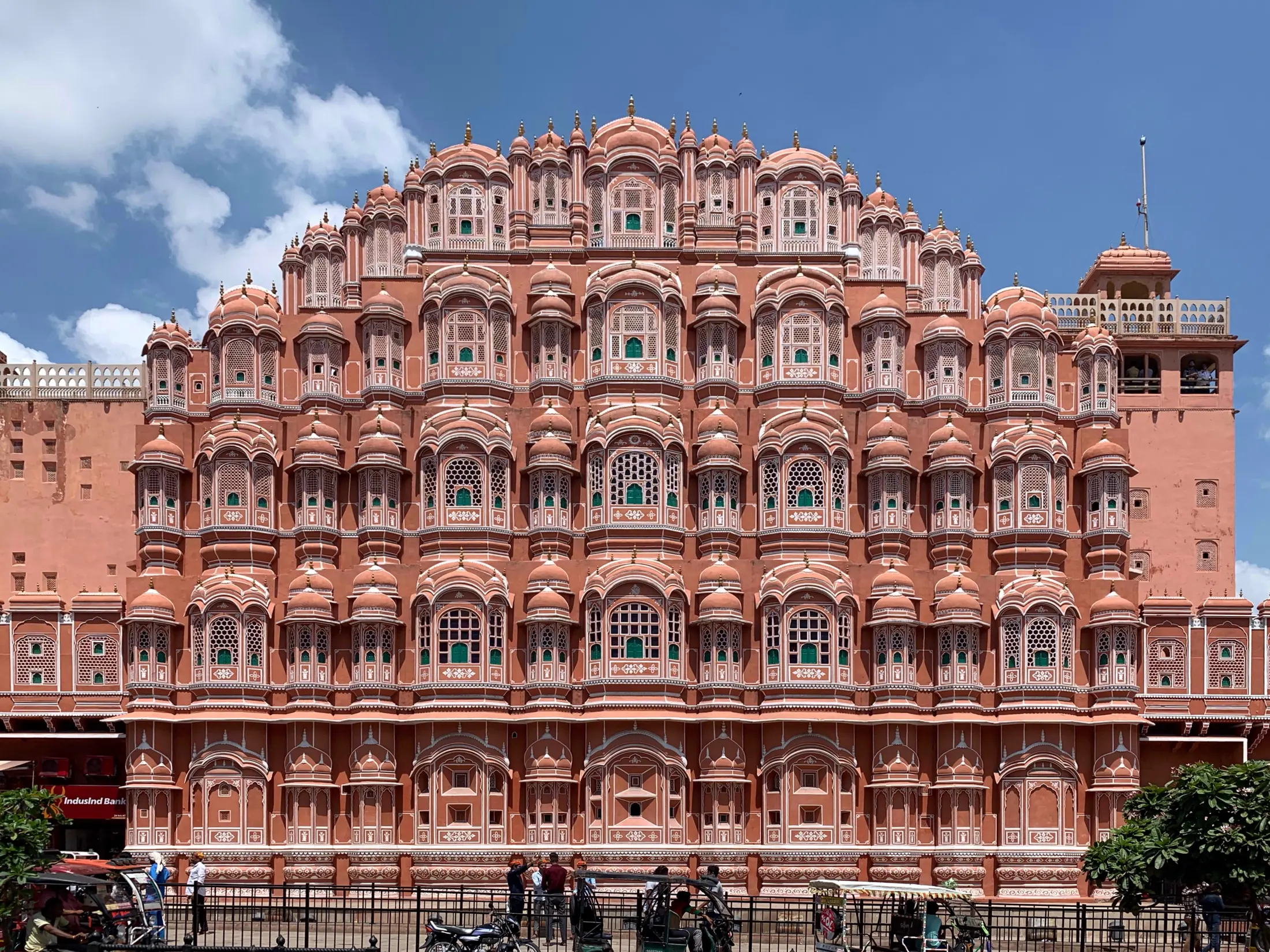
The view from Hawa Mahal
- Where: the top floors of Hawa Mahal, with the observatory below and the great gnomon above the trees.
- Why stop: from above, the geometry of the layout is clear.
The night sky the instruments were built for
- A daytime visit now: but the observatory was built for nights too.
- Go to the desert: to see the sky as Jai Singh's astronomers did. Our page on stargazing in the Thar explains where the skies are darkest.
The other observatories
- Delhi: its Jantar Mantar stands near Connaught Place. See our page on Delhi.
- Varanasi: the observatory sits on the roof of the Man Mandir above the ghats. See our Varanasi guide.
Who will love it, and who won't
Lovers of ideas: you will probably remember the Jantar Mantar long after the palaces blur together.
Who falls for it: engineers, teachers, scientists, sailors, pilots and curious children.
- Will love it
- Engineers, children, photographers, architects
- May not
- Lovers of rooms, gold leaf and queens
- Short version
- Forty-five minutes, four or five instruments
- Photographers: the shapes against a blue sky are unlike anything else in India.
- Architects: come for the geometry and stay for hours, sketching the Jai Prakash bowls and the steps of the great gnomon.
- If you love rooms and gold leaf: it can feel like a hot gravel yard with odd walls. That is fine.
- The short version: forty-five minutes with a guide who picks four or five instruments, then the textiles and painted gates of the City Palace.
- Even the unconvinced: usually leave having watched the shadow move, and most admit it was worth the half hour.
- Balancing the days: our things to do in Jaipur guide helps mix the science with everything else.
Sights to pair with the Jantar Mantar
- Facing it
- The City Palace, Virendra Pol
- A walk east
- Hawa Mahal
- Just south
- Tripolia Bazaar
- On the ridge
- Nahargarh, built 1734
The City Palace
- Where: Virendra Pol, the palace's visitor gate, faces the observatory.
- How: instruments in the late morning sun, then the palace courts and the Chandra Mahal's private rooms.
Hawa Mahal
- Where: a few minutes' walk east.
- How: its facade at sunrise, then here once the sun has climbed.
The bazaars of the old city
- Where: Tripolia Bazaar and the bangle-makers' lanes lie just south.
- Why: after the precise geometry, the market's noise and colour remind you the rest of Jaipur is still here.
Nahargarh at sunset
- The same year: Jai Singh built Nahargarh in 1734, when the observatory was completed.
- How: drive up to its ramparts at day's end and look down on the grid he designed.
Where to stay close by
- To walk there
- Samode Haveli
- Royal story
- Rambagh Palace
- For calm
- The Oberoi Rajvilas
Samode Haveli, inside the walls
- Why stay: walk rather than drive. A nobleman's haveli in the old city.
- What it's like: painted rooms, a garden pool and the bazaar lanes at the gate.
Rambagh Palace
- Where: the royal family's former residence, in its gardens south of the walls.
- Why stay: if the story of the Kachwaha kings has caught you, as it usually does after a morning here.
The Oberoi Rajvilas
- Where: outside the city.
- Why stay: calm and space after the heat and crowds of a midday visit. Our guide to luxury hotels in Jaipur compares every choice.