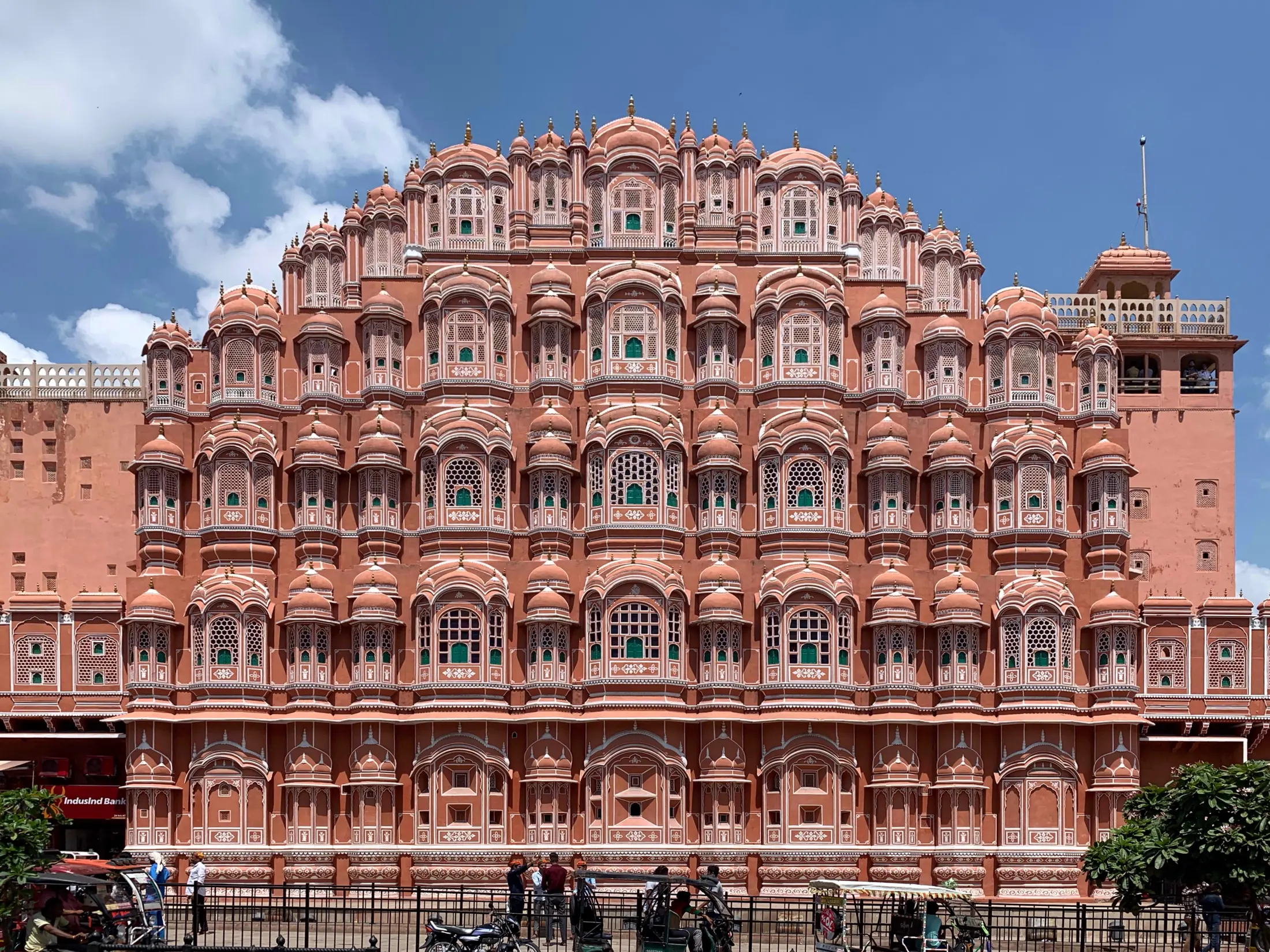
A palace at the centre of the plan
Out of the hills: for six centuries the Kachwaha kings ruled from the hills at Amer. By the 1720s the old capital was short of water and space.
A city to match his ambitions: Sawai Jai Singh II moved his court to the plain in 1727. Work on the palace began in 1729, and its core was ready within a few years.
The architect: Vidyadhar Bhattacharya, the Bengali scholar who also helped plan the city grid.
- Built
- Begun 1729, added to for two centuries
- Built by
- Sawai Jai Singh II, with Vidyadhar Bhattacharya
- Open
- Outer courts and museum; family rooms private
- Allow
- Two to three hours, more with a private tour
- Best time
- Late afternoon, or as the gates open
- Photography
- Courtyards yes, some galleries restricted
- Getting there
- Heart of the walled city, by Jantar Mantar
- Placed at the centre: the palace spans the central blocks of the new city, with the bazaars along its edges and the observatory at its gate.
- Never finished: every ruler added to it. Jai Singh built the Chandra Mahal and the great courts, and his successors added halls, gates and gardens through the eighteenth century.
- The modernising king: in the nineteenth century Sawai Ram Singh II, who painted the city pink, brought in a clock tower, gas lights and photography, which he practised himself.
- The reception palace: around 1900 Sawai Madho Singh II added the Mubarak Mahal, for receiving foreign guests.
- Family history in stone: walking through the courts is like reading it, one generation per gateway.
- 1949: Jaipur joined the new state of Rajasthan, and Maharaja Sawai Man Singh II became its first Rajpramukh, the ceremonial head of state. He was the last ruler to govern from the Chandra Mahal.
- Opened as a museum: having already made Rambagh his home, he opened much of the palace as a museum in the 1950s. It still bears his name. Rambagh became a hotel in 1957.
- Still home: the family lives in part of the Chandra Mahal today. Our piece on the Jaipur royal family follows the story to the present.
A palace built in rings
Outer courts: for the public business of the state, with audiences, ceremonies and the coming and going of nobles, traders and envoys.
Inner courts: for the royal household.
The innermost rooms: in the Chandra Mahal and the women's palace, closed to almost everyone.
- Udai Pol
- Near Jaleb Chowk, towards the Sabha Niwas
- Virendra Pol
- Opposite Jantar Mantar, the main visitor entry
- Tripolia
- The triple gate, for the royal family only
- Faces
- North, to Govind Dev Ji
- It still works that way: visitors move freely through the outer courts, the inner ones are seen by private arrangement, and the family's living rooms are not seen at all.
- Udai Pol: near Jaleb Chowk, leading towards the Sabha Niwas.
- Virendra Pol: opposite the Jantar Mantar, leading into the courtyard of the Mubarak Mahal. Most visitors enter here.
- Tripolia: the triple gate on Tripolia Bazaar, reserved for the royal family. Its doors open for processions and family occasions, a small event in the old city.
- Built by the old texts: Jai Singh's planners followed the vastu shastra, the Indian texts on architecture, in which every direction has its meaning.
- The line of sight: the royal residence faces the god Govind Dev Ji in the garden to the north, and the king's daily life was arranged around that line.
- The spine of the city: when our guides stand you in the Chandra Mahal courtyard and point north, through the gardens to the temple, that is what they are showing you.
Court by court, the way we walk it

- Enter
- Virendra Pol
- First
- Mubarak Mahal and the textile gallery
- Heart
- Sarvato Bhadra and the silver urns
- Most photographed
- Pritam Niwas Chowk
- End
- The garden and Govind Dev Ji
The Mubarak Mahal and the textile gallery
What it is: the auspicious palace, completed around 1900 for Sawai Madho Singh II as a hall for receiving guests.
Its architect: Lala Chiman Lal, who had worked with Samuel Swinton Jacob, the engineer behind Albert Hall.
- Like ivory: carved balconies, fine marble screens and a pale facade make it look like ivory from a distance.
- The textile gallery: royal costumes, shawls, wedding dress, block-printed and embroidered cloth, and a rare pashmina carpet of the mid-seventeenth century.
- Look for: the vast robes said to have belonged to Sawai Madho Singh I, a king remembered for his great size.
The arms and armour gallery
The Sileh Khana: the armoury of a warrior dynasty, with jewelled sword hilts, shields of hide and steel, the punch daggers called katar, chain mail and helmets.
- With children: they usually want to stay longest here.
- Ask your guide: to point out weapons with Mughal and Persian inscriptions. The Kachwahas were Mughal generals for generations, and the line between ally and rival was always thin.
Rajendra Pol and the Sarvato Bhadra
The gateway: Rajendra Pol, in marble, flanked by carved stone elephants.
- The hall: the Sarvato Bhadra, the hall of private audience also called the Diwan-i-Khas, a single open pavilion of pink and cream, square in plan, with rooms at its four corners.
- What happens here: coronations, Dussehra ceremonies and the start of festival processions. The family still uses it for celebrations and weddings.
The silver urns
What they are: two giant silver urns called gangajali, each about 1.6 metres tall and around 340 kilograms.
Why they exist: made for Sawai Madho Singh II, a devout Hindu who went to London in 1902 for Edward VII's coronation and would not, the story goes, drink any water but the Ganges.
- Melted coins: they carried his holy water across the sea, and were made from thousands of melted silver coins.
- A record: Guinness World Records lists them as the largest sterling silver vessels in the world.
- The photograph: everyone takes the same one. Take it anyway.
The Sabha Niwas, the hall of public audience
What it is: the Diwan-i-Aam, a long hall of cusped arches, marble columns and a painted ceiling, where the king sat in public durbar.
- What's inside: royal portraits, thrones, carpets and polo trophies, a reminder that Jaipur's royal family has been one of the great names in Indian polo.
- The screens: at the southern end, the palace women watched the court from behind lattices, as they watched the street from Hawa Mahal.
Pritam Niwas Chowk, the court of the beloved
Where: a small inner courtyard at the foot of the Chandra Mahal, the most photographed place in the palace.
Four doorways: for the four seasons and four deities.
- Peacock Gate: north-east, autumn and Vishnu. Lotus Gate: south-east, summer and Shiva with Parvati.
- Leheriya Gate: the green one, north-west, spring and Ganesha. Rose Gate: south-west, winter and the goddess Devi.
- Give it ten minutes: the Peacock Gate's painted plaster, with birds in relief and glowing blue and green, is worth it on its own.
The Chandra Mahal
The moon palace: seven storeys tall, seven being an auspicious number for the Rajput kings.
- What you can see: the lower floors and some upper rooms on private tours. The family's apartments are private.
- The flags: the royal standard of Jaipur flies at all times, and an extra quarter flag joins it when the head of the family is in residence.
- Why a quarter: it stands for sawai, one and a quarter, the title the Mughal emperor gave Jai Singh II to say he was worth more than one ordinary man.
The garden and the god
Where: north of the Chandra Mahal, the Jai Niwas garden and the temple of Govind Dev Ji, Krishna as the cowherd god.
- The image: brought to Jaipur from Vrindavan in the Mughal period. The Kachwaha kings saw themselves as the god's first servants.
- Visiting: the temple is open to all through its own entrance.
- Come for a jhanki: the moments when the curtain before the image is drawn back and the crowd breathes in together.
The private rooms of the Chandra Mahal

A name for every floor: the lower floors are the Sukh Niwas, the house of pleasure.
Above them: the Shobha Niwas, glittering with coloured glass and mirror work, and the Chhavi Niwas, cool in blue and white.
At the top: the Shri Niwas and the Mukut Mandir, the crown temple, which carries the roofline and the flags.
- Sukh Niwas
- The lower floors, the house of pleasure
- Shobha Niwas
- Coloured glass and mirror work
- Chhavi Niwas
- Cool in blue and white
- Top floors
- Shri Niwas and the Mukut Mandir
- Best time
- Early, or late afternoon
- The climb: like moving from a drawing room into a jewel box and then out onto the roof of the city.
- Private tours: the palace takes small groups into some of these upper rooms with a palace guide.
- No promises: which rooms are shown varies with the family's own use of the building, and we never promise a particular room.
- What you'll see: gilded and mirrored chambers, family photographs and painted ceilings, then terraces looking across the walled city to Nahargarh on the ridge.
- The memorable hour: for most of our guests, the most memorable of their time in Jaipur.
- Private dinners: for a truly special occasion, the palace has hosted dinners in its courtyards, which we can sometimes arrange.
- Read more: a private dinner in a palace and meeting Rajasthan's royal families.
Rajput, Mughal and a little of Europe
Jai Singh's age: the Chandra Mahal and the main courts have the chhatris, overhanging balconies and stepped rooflines of Rajput palaces, laid out with Mughal symmetry and arches.
Local materials: pink and yellow sandstone, lime plaster polished to a soft shine called araish, and marble for floors and columns.
The colours: mineral and vegetable, many restored over the years by families of painters who have worked for the palace for generations.
- Rajput
- Chhatris, balconies, stepped rooflines
- Mughal
- Symmetry and arches
- Materials
- Pink and yellow sandstone, araish, marble
- European
- Clock tower, chandeliers, cast iron
- A purely Indian form: Sarvato Bhadra means auspicious on all sides, a square pavilion open in every direction, ideal for a king who wanted to be seen from every corner.
- The Mubarak Mahal: a building of 1900, when architects were inventing a style for princely India. Its carving and screens are Rajput and Mughal.
- Swinton Jacob's influence: its plan and sense of display owe something to his Indo-Saracenic buildings, among them the Albert Hall Museum.
- European touches: mostly from Ram Singh II's reign, including a clock tower south of the Sabha Niwas with a clock from Calcutta fitted in 1873, glass chandeliers, framed photographs and cast-iron fittings.
- Kings unafraid of new ideas: Jai Singh built an observatory, Ram Singh took up the camera, and Madho Singh shipped Ganges water to London in silver.
- Learn the vocabulary: our guide to Rajasthani architecture explains the domes, arches and screens.
When the palace comes alive

Gangaur and Teej: during Gangaur in March or April and Teej in July or August, the goddess is carried out of the women's palace in a palanquin.
Through Tripolia: the procession leaves through Tripolia Gate into the bazaar, with women in their best saris and leheriya lining the route.
Inherited rooftops: families claim the same rooftop spots their grandparents used.
- Gangaur
- March or April, procession from Tripolia
- Teej
- July or August, the goddess in a palanquin
- Dussehra and Diwali
- Autumn ceremonies and oil lamps
- Makar Sankranti
- 14 January, kites from the roofs
- Polo
- Winter season, by Rambagh
- A viewing area: the palace sometimes opens one for guests. It is one of the few times you see the old order of the city moving through its streets.
- Dussehra: ceremonies in the palace mark the victory of good over evil.
- Diwali: the courts are lit with oil lamps.
- Makar Sankranti, 14 January: the palace roofs join the city in flying kites. See Makar Sankranti.
- Polo: the winter Jaipur polo season brings matches on the grounds by Rambagh.
- The great player: Maharaja Sawai Man Singh II was one of the best of his day, and the trophies in the Sabha Niwas come from that world. Read about polo in Jaipur.
The best hour, and the best season
Late afternoon: the tour groups have gone on to Amber or lunch, the low sun lights the painted gates from the side, and the Chandra Mahal glows.
A perfect ending: a late-afternoon private tour, then a walk out into the evening bazaar.
Evening openings: the palace opens on some nights, lovely if you want to see the courts lit.
- Best hour
- Late afternoon
- Or
- Opening time, Pritam Niwas Chowk first
- Avoid
- Noon on a winter day
- Best season
- October to March
- Festival days
- Visit in the morning
- Mornings: arrive as the gates open, see Pritam Niwas Chowk first while it is quiet, and work backwards to the galleries.
- A perfect morning: pair it with the Jantar Mantar, whose sundials read best near midday.
- October to March: the comfortable season.
- April to June: the stone courts hold the heat, so go early and stay in the shaded galleries.
- Festival days: on Gangaur and Teej the area around Tripolia Gate fills from early afternoon and the palace is busy with preparations. Visit in the morning and keep the afternoon for the street.
- Moving dates: festivals follow the lunar calendar, so ask us about the dates each year.
How to visit
Hire a good guide: the palace has many layers and most labels say very little. A guide who knows the family's stories turns rooms of objects into a history.
Book the private tour ahead: places are limited, and the rooms shown depend on the family's own use of the palace.
- Guide
- Essential, labels say very little
- Private tour
- Book ahead, places limited
- Dress
- Shoulders covered
- Access
- Mostly one level; Chandra Mahal has stairs
- Photography: allowed in the courtyards but restricted in some galleries. The family's portraits and private areas are not for selfies.
- Access: most courts are on one level with some steps and thresholds. Guests with limited mobility can see the outer courts and Pritam Niwas Chowk with care. The upper floors involve stairs.
- Dress for a family home: shoulders covered is courteous, and essential if you continue to the Govind Dev Ji temple.
- Shops inside: some craft workshops are excellent, but buy because you love the piece, not because someone steered you there.
- Etiquette: our guide to palace etiquette covers greetings, dress and how to address members of a royal family if you meet them.
What most visitors miss
The quarter flag
- Look up first: before you go in, check the top of the Chandra Mahal. Two flags mean the head of the family is at home.
- Local habit: locals check it without thinking, the way other people check the weather.
The view north to the temple
- Find the spot: from the right place near the Chandra Mahal you can look straight through the gardens to Govind Dev Ji. Ask your guide.
- Why it matters: it is the line around which the whole palace, and arguably the whole city, was set out.
The craftsmen at work
- Who: families of painters, printers and enamellers who still work inside the precincts, for the palace and for visitors.
- Ten quiet minutes: watch a miniature painter grind his colours or lay a hair-fine brushstroke. Our page on miniature painting explains the craft.
The photographs of Ram Singh II
- The archive: thousands of paintings, photographic prints and glass plate negatives, many from the photographer-king's reign.
- When they're on show: look at his portraits of the palace women, taken when almost nobody outside the family could see them.
Sights to pair with the City Palace
Jantar Mantar, across the courtyard
- Where: just outside Virendra Pol. The astronomer-king built his observatory at his own front door.
- How: see it in the same visit, with a guide who can make the instruments speak.
Hawa Mahal, on the palace's eastern edge
- What it was: the palace of the winds was built as part of the palace's women's quarters.
- How: see it at sunrise, then walk to the City Palace for opening time.
The bazaars around the walls
- Walk west: leave by Tripolia Bazaar for brass and household goods, or turn into the lanes of the bangle-makers.
- Lane by lane: our guide to the bazaars of Jaipur lays out the old trades.
Nahargarh on the ridge
- Where: on the hills to the north-west, visible from the palace terraces.
- How: end the day there at sunset and look back down at the palace you walked through in the morning.
Where to stay close by
Rambagh Palace
- Its history: a garden house of 1835 that became the home of Maharaja Sawai Man Singh II and Maharani Gayatri Devi, then a hotel in 1957.
- Why stay: after a day in the City Palace, it completes the story of the family in a way no museum can.
Samode Haveli
- Where: a nobleman's haveli inside the walled city, so you can walk to the palace in the morning.
- Why stay: painted rooms and a quiet garden, a good counterweight to the grandeur of the palace.
Jai Mahal Palace and The Raj Palace
Jai Mahal: Jai Mahal Palace stands in Mughal-style gardens outside the walls.
- The Raj Palace: The Raj Palace is a restored nobleman's palace near the northern gates.
- Both: a short drive from the City Palace. Our guide to luxury hotels in Jaipur compares them all.