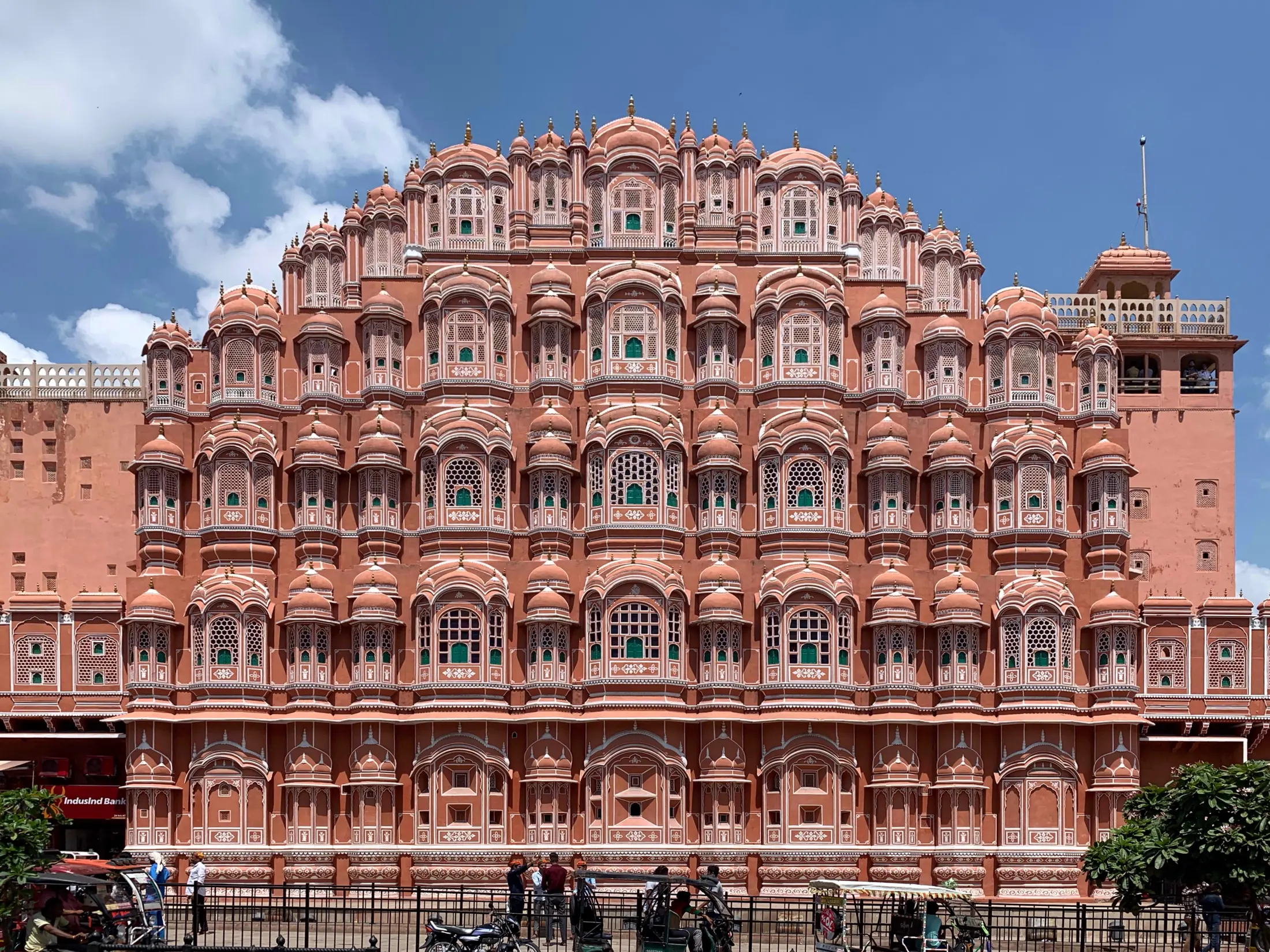
A poet-king and a wall of windows

Not the founder's work: Hawa Mahal was built by Jai Singh II's grandson, Sawai Pratap Singh, who came to the throne as a boy in 1778, half a century after the city was laid out.
A hard reign: the Marathas pressed hard on Rajasthan, the treasury was strained and the court was full of rival nobles.
A poet first: Pratap Singh is remembered less as a soldier than as a patron of poetry, music and painting.
- Built
- 1799
- Built by
- Sawai Pratap Singh, architect Lal Chand Ustad
- Open
- Inside by day, facade lit after dark
- Allow
- An hour inside
- Best time
- Just after sunrise, for the facade
- Photography
- Allowed inside
- Getting there
- On the main bazaar by Badi Chaupar
- Brajnidhi: he wrote devotional verse to Krishna himself, and the old families will tell you he signed it Brajnidhi, the treasure of Braj, the land where Krishna grew up.
- 1799: he added this strange and lovely building to the eastern edge of the palace, with his architect Lal Chand Ustad, ustad meaning master.
- A building barely a room deep: a facade five storeys high, pierced by 953 small windows and latticed openings, set right on the main bazaar.
- A pink curtain of stone: from the street it looks like a palace. From the side it is closer to a screen, hung between the royal women's quarters and the life of the city.
- Krishna's crown: our grandmother said the outline was meant to be Krishna's crown, rising in tiers to a point. Nobody has found that written down, and historians are careful about it.
- Why the story lasts: with the morning sun on its curved roofs and tiny domes climbing to the centre, the building a devotee of Krishna built looks to most of Jaipur like a crown.
- The name: hawa is wind and mahal is palace. It earned the name in the hot months, when air pulled through hundreds of openings kept the inner rooms bearable.
- Still true: two centuries later the street still calls it the palace of the winds, and on a May afternoon you can still feel why.
Why the women of the palace needed windows
Purdah: Rajput royal households kept the custom that screened high-born women from the sight of men outside the family.
The zenana: queens, princesses and their companions lived in the women's quarters of the City Palace, a world of courtyards, gardens and painted rooms that strangers never entered.
- Purdah
- Screening royal women from men outside the family
- Zenana
- The women's quarters of the City Palace
- Jali
- The stone lattice, a one-way mirror
- They watched
- Teej, Gangaur, weddings, the bazaar
- A world of their own: they had music, poetry, festivals and politics. What they did not have was the street.
- Hawa Mahal gave it to them: it stands at the palace's edge, connects to the women's side, and its upper floors look straight down onto the main bazaar.
- What they saw: processions of Teej and Gangaur, wedding parties with brass bands, horses and elephants of state, traders arguing over cloth, the slow theatre of a royal capital.
- The jali trick: the stone lattice worked like a one-way mirror. In daylight the street saw only pattern and shadow. The women inside saw everything.
- Two ideas at once: the building is enchanting, and it is also a monument to a life of strict seclusion.
- How much has changed: granddaughters of families who once lived behind those screens now run businesses, sit in parliament and argue in the same bazaar.
Inside, floor by floor
- Way in
- Round the side, not the facade
- Sharad Mandir
- The autumn rooms and terraces
- Ratan Mandir
- Coloured glass
- Vichitra Mandir
- Where the king worshipped Krishna
- Top
- Prakash Mandir and Hawa Mandir
- Getting up
- Ramps only, no stairs
The gate and the courtyard
Not through the facade: the way in is round the side, through a gateway into a broad courtyard with double-storeyed buildings on three sides.
- The first surprise: the rear of Hawa Mahal is plain, almost severe, with simple arcades and corridors. All the ornament went on the face the city sees.
- A small museum: sculpture and objects in the courtyard. Give it ten minutes, but save your energy for the climb.
Sharad Mandir, the autumn rooms
The name: sharad is the clear, gentle season after the monsoon, and its celebrations are said to have been held here.
- Still a palace: rooms open onto terraces, with space to sit and the traces of fountains that once played in the courtyards.
- Pause at the edge: the first place you can look straight down onto the bazaar, and feel how close the women were to a street they could not walk in.
Ratan Mandir, the room of glass
The name: for its jewel-like glasswork, with coloured panes set into the windows and arches.
- For children: every step changes the colour of the light.
- Ask your guide: how the panes line up with the street, so a woman sitting here saw a stretch of bazaar tinted the colour of a gem.
Vichitra Mandir, the king's devotion
Tradition says: this is where Pratap Singh came to worship Krishna.
- The building narrows: the upper floors are only one room wide, a wall with rooms in it.
- Feel it: put your hand on the stone beside a window and feel the breeze moving through, even on a still day.
Prakash Mandir and Hawa Mandir, the top
What's there: narrow galleries and small chambers under the roofs.
- Ramps, not stairs: easier for women in heavy skirts and, it is said, for palanquins.
- The finest gift: the whole old city laid out around you.
How a screen became a building
A stepped pyramid: red and pink sandstone, each storey set slightly back, so the building seems to lean away from the street as it rises.
Jharokhas: small projecting windows, each with its own curved roof, scalloped arch and latticed screen. Repeat that nearly a thousand times and you get the honeycomb, so easy to recognise and so hard to draw.
Rajput parts: the domed kiosks and the overhanging balconies are Rajput, and the curved Bengal-style roofs came to Rajasthan through Mughal building.
- Stone
- Red and pink sandstone
- Shape
- A stepped pyramid, five storeys
- Windows
- 953 jharokhas and latticed openings
- Painted pink
- 1876
- Restored
- Early 2000s
- Mughal parts: the fine stone lattice, the cusped arches and the sense of geometry, known intimately after two centuries of Kachwaha alliance with Delhi and Agra.
- A style of their own: Jaipur's builders blended both, and Hawa Mahal is its most theatrical example.
- Read more: our guide to Rajasthani architecture and our piece on what a jharokha is.
- Real cooling: small openings speed up moving air, as water speeds through a narrow channel. Hundreds at different heights on a thin building facing the morning create a steady draught.
- Old desert wisdom: courtyard fountains once added moisture. Desert builders used the same trick for centuries. Here a poet-king made it a monument.
- The colour came later: in 1876 Maharaja Ram Singh II had the walled city painted for the Prince of Wales. Read why Jaipur is pink.
- Cared for: carefully restored in the early 2000s. Even small repairs to the facade become a public argument in the newspapers.
The right hour, and the right season

Dawn: in the first hour after sunrise the facade catches the light full on, and the pink turns a warm coral.
An empty street: shopkeepers sweep their steps, a few cows think about the day, and chai sellers light their stoves.
By nine and ten: traffic starts, then the pavement opposite fills with tour groups and selfie sticks. By mid-morning the sun is overhead and the facade goes flat.
- Facade
- First hour after sunrise
- Inside
- As the gates open
- Late afternoon
- Rooftops glow, facade in shadow
- After dark
- Lit, from Badi Chaupar
- Best season
- October to March
- Inside: visit once the gates open, when the rooms are cool and quiet, with coloured light through the glass.
- Late afternoon: the facade falls into shadow and the rooftops behind glow, when photographers climb to the cafes opposite.
- After dark: the lit facade floats above the evening traffic at Badi Chaupar, a good last stop after dinner in the old city.
- Winter: December and January mornings are crisp, sometimes close to freezing, so bring a shawl.
- Summer: from April to June, come at first light and be back in your hotel by eleven.
- Monsoon: the sky after rain is washed clean and the sandstone darkens to a deep rose. Some of our favourite photographs were taken in August, between showers.
- Kite day: on Makar Sankranti, 14 January, the sky above Hawa Mahal fills with kites from dawn to dusk, and every roof in the bazaar is shouting.
- Processions: during Gangaur in spring and Teej in the monsoon, the royal processions bring the old city out in its finest clothes.
- Diwali: the bazaar below is lit end to end.
- What it was made for: these are the days the building was built to watch.
How to visit well
Facade first: see it at sunrise from the far pavement or a rooftop opposite, then walk round once the gates open. Don't try both at eleven.
Hire a guide: without one it is a pleasant climb. With one, each floor has a story. Ours grew up in the walled city and know which rooms the street still argues about.
- Order
- Facade at sunrise, then inside
- Guide
- Worth it for the stories
- Shoes
- Good grip, the ramps are worn
- Access
- Courtyard and lower floors manageable
- Shoes matter here: no lifts and no stairs, only ramps, some steep, narrow and worn smooth. Grip matters more here than at any palace in Jaipur.
- Limited mobility: the courtyard and lower floors are manageable with help, the top floors tight. See accessible travel.
- Photography: allowed inside. The best frames are views through the lattice and coloured light on the floors, not the crowded top gallery. Don't climb on the window ledges.
- The traffic: it never really stops. Cross with your guide or chauffeur at the lights near Badi Chaupar, and don't step back into the road for a photograph.
- Sellers: you'll be offered everything from postcards to puppets. A smile and a gentle no is enough, and we never take guests to commission shops.
What most visitors miss
The view of the observatory from the top
Look west: over the palace roofs to the great sundial of the Jantar Mantar above the trees.
- Beyond it: the seven storeys of the Chandra Mahal in the City Palace, and Nahargarh on the ridge.
- One window: palace at the centre, science beside it, fort above. Jai Singh's whole plan fits in it.
The street through the lattice
- How: stand back from an upper window and look through the jali rather than over it.
- Why: you see the bazaar as the palace women did, in fragments, framed and filtered. The most moving minute in the building.
The back of the building from outside
- Ask your guide: for a lane where the side of the building is visible.
- Edge-on: the famous palace shrinks to a pink wall with a few rooms clinging to it. Nothing explains its purpose better.
The bazaar at its feet
- A working market: brass lamps, turbans, wedding cards and kitchen pots, much as when the windows above were full of watching eyes.
- Walk it slowly: in both directions. Our guide to the bazaars of Jaipur explains which lane sells what.
Sights to pair with Hawa Mahal
The City Palace
Why together: Hawa Mahal was built as part of the palace.
- Still a home: the royal family lives in the Chandra Mahal, and the private rooms are worth the extra arrangement.
- Order: Hawa Mahal first, early, then the palace.
The Jantar Mantar
- Where: a few minutes' walk away, beside the palace gates.
- When: its giant sundial reads best when the sun is high, a perfect late-morning follow-on to a dawn at Hawa Mahal.
Govind Dev Ji temple
Where: behind the Chandra Mahal, in the old palace garden. The temple of Krishna as Govind Dev Ji, the city's most loved deity.
- The image: brought from Vrindavan in the Mughal period. The royal family regard the god as the true ruler of Jaipur.
- Visiting: join the crowd for a jhanki, when the curtain is drawn back. Dress modestly and slip off your shoes.
Johari Bazaar and the lanes of craft
- Where: Badi Chaupar, at the southern end of the street, opens into Johari Bazaar, the jewellers' street.
- Our favourite walk: down Johari Bazaar from Hawa Mahal, with kachori and lassi on the way. Our heritage walks begin here.
Albert Hall at night
- Where: outside the walls to the south, lit up after dark.
- Bookends: Hawa Mahal at dawn and Albert Hall at dusk frame a day in the city.
A morning built around Hawa Mahal
- Start
- Badi Chaupar, street lights still on
- Breakfast
- Kachori, a sweet, a thick lassi
- Late morning
- Jantar Mantar, then City Palace
- Afternoon
- Lunch and rest at your hotel
Dawn on the bazaar
Drop-off: your chauffeur leaves you at Badi Chaupar while the street lights are still on.
- Watch the light: walk the bazaar as the sun comes up over the rooftops opposite and lights the facade, then sit on a rooftop with masala chai in a clay cup.
- By bicycle: our dawn cycling tours of the old city pass right beneath the windows.
Inside, as the gates open
- Climb early: walk round with your guide and climb floor by floor before the groups arrive. Spend longest at the top.
- Breakfast in the bazaar: hot kachori, a sweet from the halwai, and a lassi thick enough to eat with a spoon.
The palace and the observatory
Late morning: the Jantar Mantar, when the shadows are sharpest, then the City Palace.
- Afternoon: lunch in the cool of your hotel, and rest.
- Go further: this rhythm is the backbone of our Jaipur in three nights journey, and our Jaipur itinerary guide has longer versions.
Where to stay close by
Samode Haveli, inside the walled city
- What it is: a nobleman's townhouse with painted rooms, a garden pool and a mural-covered dining room.
- Why stay: the luxury address closest to Hawa Mahal. Walk out at dawn, be in the bazaar in minutes, and come back to breakfast on the terrace.
Rambagh Palace, the grand option
- Where: south of the walls, a short drive at that hour.
- The trade-off: a few minutes in the car for gardens, peacocks and the history of the family who built both buildings.
The Raj Palace and Jai Mahal Palace
The Raj Palace: The Raj Palace is a restored nobleman's palace near the northern gates.
- Jai Mahal: Jai Mahal Palace is set in Mughal-style gardens to the west.
- Both: an easy early-morning drive. Our guide to luxury hotels in Jaipur compares every option.
Who will love Hawa Mahal
Photographers: the facade at dawn from across the road, the coloured light on the floors of the Ratan Mandir, and the whole old city from the top.
Families with children: the Ratan Mandir is the floor children love, because every step changes the colour of the light.
- History lovers: a poet-king, the life of purdah and two centuries of Kachwaha alliance with the Mughals, all in one building. Come with a guide.
- Architecture lovers: Rajput and Mughal forms blended into Jaipur's own style, and a cooling system that really works.
- Limited mobility: the courtyard and lower floors are manageable with help. The upper floors are reached only by narrow ramps.
- Short on time: see the facade at sunrise and again after dark. If you go inside, give it an hour.
A few things we tell our own family
The best photograph: from across the road and slightly to one side, so the tiers stack up. See the best photo spots in Jaipur and our photography tips.
Rooftop cafes: order something and stay a while. The owners are kind to photographers who are also customers.
- Look up: pigeons, monkeys and the occasional parakeet use the windows, and in winter the morning light catches them in the lattice.
- Take your time: don't be rushed round in twenty minutes. An hour inside is not too long if you look through the windows on each floor.
- Walk, don't hop: the building only makes sense as part of the street it was built to watch.
- Come back at night: even for five minutes. The lit facade above the headlights and the bells of the bazaar temples are a different city.
- Read a little first: ten minutes on the Kachwaha kings, or our piece on the Jaipur royal family, turns a pretty building into a chapter you can follow across the city.
- Hot months: carry water and climb in the first hour after opening. The upper galleries are breezy, but the courtyard holds the heat by late morning.


